
Iguazú Falls Flood, October 2026: Devil's Throat Walkway Closed 11-30 October, Reopened 31 October
The Devil's Throat walkway at Iguazú Falls was closed from 11 to 30 October 2026 and reopened on 31 October. The operator's figures, dated, and the two closure thresholds it gives.
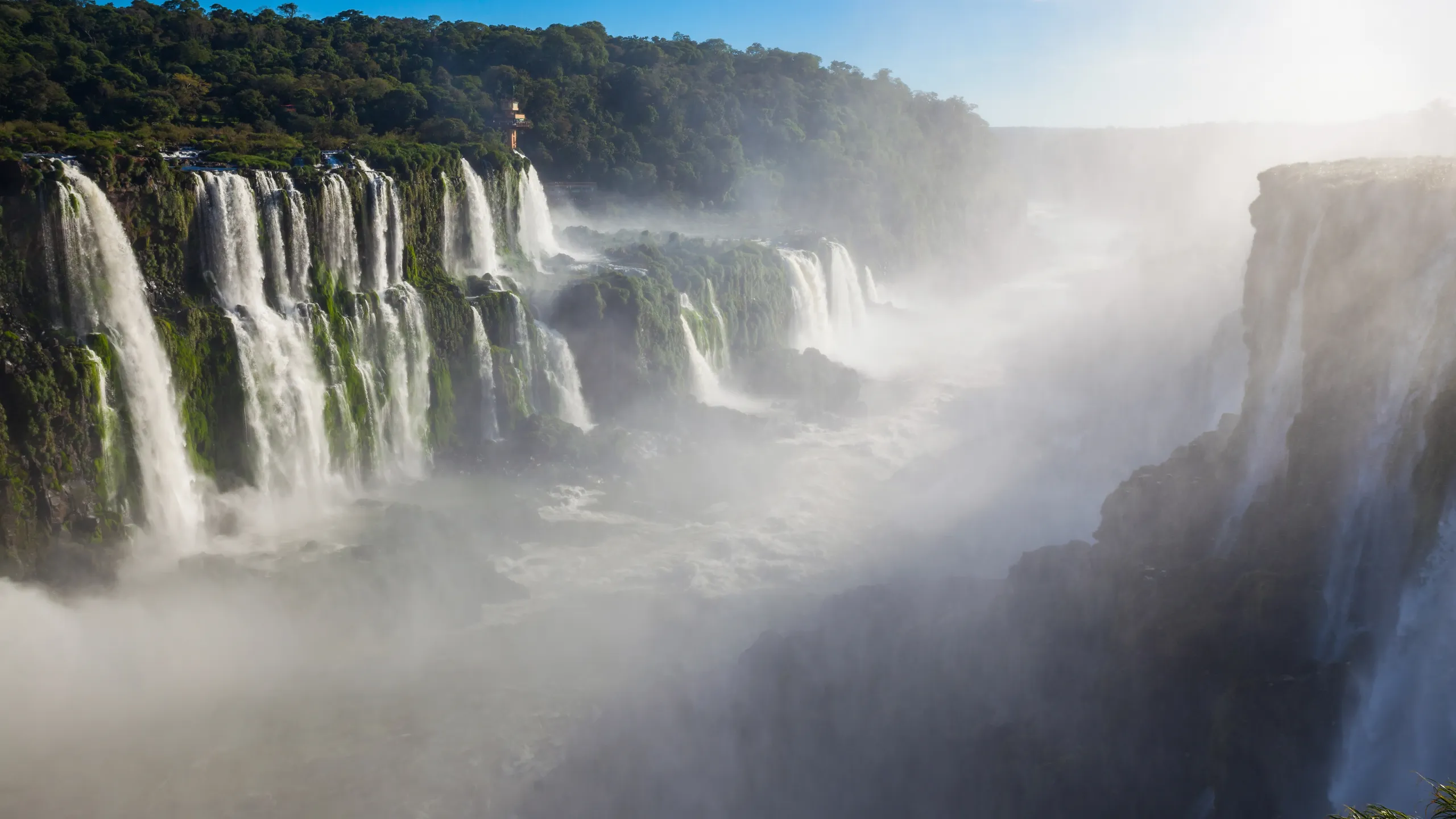
The Iguazú Falls flood of October 2026 kept the Devil's Throat walkway on the Brazilian side closed for 20 days, from 11 to 30 October, and the walkway reopened on Saturday 31 October at 10:00. That is what Urbia+Cataratas, the concessionaire that runs visitor access at Iguaçu National Park, says in its own news posts. The river peaked at 17.7 million liters per second in the early hours of Monday 26 October, and the operator put it at 6.8 million on the Saturday it reopened. Status as read on 12 November 2026 from the park's news page (cataratasdoiguacu.com.br): the latest notice about the walkway is the reopening. Dates and rules change: check the official source before you travel.
We earn a commission if you book a tour through this site. It does not change the price you pay. How we work.
One safety note first. The walkway closes on purpose when the river rises, and the park's own protocol is the reason. Do not go around a barrier or onto a path the operator lists as closed, and expect access to shut again if the flow climbs. Our guide to what park services tell visitors about waterfall safety covers the general rules; this article only reports what the operator published.
What the operator announced about the Iguazú Falls flood
Three posts on the park's official news page carry the whole story, and all three are in Portuguese. Urbia+Cataratas manages tourism at the park; the park itself is administered by ICMBio, Brazil's federal biodiversity agency, according to the operator's own boilerplate. We read the three posts on 12 November, as raw page text rather than through a summary tool, and every figure below comes from one of them.
The first, dated 13 October, explains the safety protocol while the flood was rising. It says the walkway had been closed since Sunday 11 October, and that the river reached 11.8 million liters per second on the morning of Monday 12 October, the largest volume recorded up to then in 2026, in the operator's words. On Tuesday 13 October it gave 10.5 million and a forecast that flow could reach 13 million in the following hours.
The second, dated 26 October, is the peak notice: 17.7 million liters per second in the early hours of that Monday, already falling to about 16 million by the morning. The operator headlined it as the largest volume of the year and invited visitors to come and see the high flow. We report that invitation as the operator's, not ours, and the next section of this article is about what it actually kept open.
The third, dated 31 October, is the reopening. It says the walkway, which leads to the Devil's Throat viewpoint (the main drop on the Brazilian side), reopened at 10:00 on Saturday 31 October after the river fell back and specialists assessed the structure and reinstalled the guardrails. That order matters: the guardrails had been taken down during the flood, so reopening was a rebuild as much as a lifting of a closure.
The closure, dated: 11 to 30 October
The table below puts the operator's figures in one place. We only include a row when one of the three posts states the date, the flow and the status together, so some days have no row. The gaps are real: the operator did not publish a daily series, and neither do we.
| Date (2026) | River flow (liters per second) | Walkway and paths, as stated | Post |
|---|---|---|---|
| Sun 11 Oct | Not stated | Walkway closed from this day | 13 Oct post |
| Mon 12 Oct | 11.8 million (morning) | Circuito São João and Espaço Usina closed as a precaution | 13 Oct post |
| Tue 13 Oct | 10.5 million; forecast 13 million | Walkway railings dismantled; Trilha das Cataratas open; lower viewpoint at Espaço Naipi closed | 13 Oct post |
| Mon 26 Oct | 17.7 million overnight; about 16 million by morning | Walkway, Circuito São João, Espaço Usina and Caminho do Poço Preto closed; Trilha das Cataratas, Trilha da Canafístula and the cycle path open | 26 Oct post |
| Sat 31 Oct | 6.8 million | Walkway reopened at 10:00 after inspection and reinstallation of the railings | 31 Oct post |
Read as a sequence, the closure has three phases. The walkway shut on 11 October, before the biggest numbers arrived. The river then kept climbing for two weeks and peaked on 26 October, which is also the day the operator said reopening depended on the river's condition and on a technical assessment of the structure. And the reopening came five days after the peak, once the flow had fallen to well under half of it.
A passarela foi interditada quando o Rio atingiu os 8,5 milhões de litros por segundo, e chegou aos 17,7 milhões na segunda-feira, 26.
Our translation: the walkway was closed when the river reached 8.5 million liters per second, and it reached 17.7 million on Monday the 26th. The same post is the clearest single statement of the closure window: the structure went through a closure after the Iguaçu River's flow rose between 11 and 30 October. Counting both end days, that is 20 days. Nothing in the posts says how many visitors were turned away or what was refunded, so this article says nothing about either.
What 17.7 million liters per second means
A million liters per second is 1,000 cubic meters per second, so the October peak was about 17,700 m³/s (roughly 625,000 cubic feet per second, our conversion). The operator compares it with a historical average of 1.5 million liters per second, which is 1,500 m³/s. These are the operator's numbers; the posts do not name the gauge or the method behind them, so we cannot say how they compare with figures from a hydrological agency.
The operator's own comparison is that the flow corresponds to 11 times the historical average. Our arithmetic gives a slightly different picture. 17.7 divided by 1.5 is 11.8, while the roughly 16 million quoted for that Monday morning gives 10.7, which rounds to 11. The post does not say which figure it used, so the safest reading is "about 11 times, give or take, on the operator's numbers", and we would not quote a more exact ratio.
We do not call this a record. The operator's headline calls it the largest volume of the year and says nothing more, and a single year is all the three posts claim. Comparisons with other floods would need a long series from a gauge, and we did not read one for this piece. For how water levels at big falls are usually read, our guide on when a waterfall has water explains the basics.
What high water looks like from the forest side
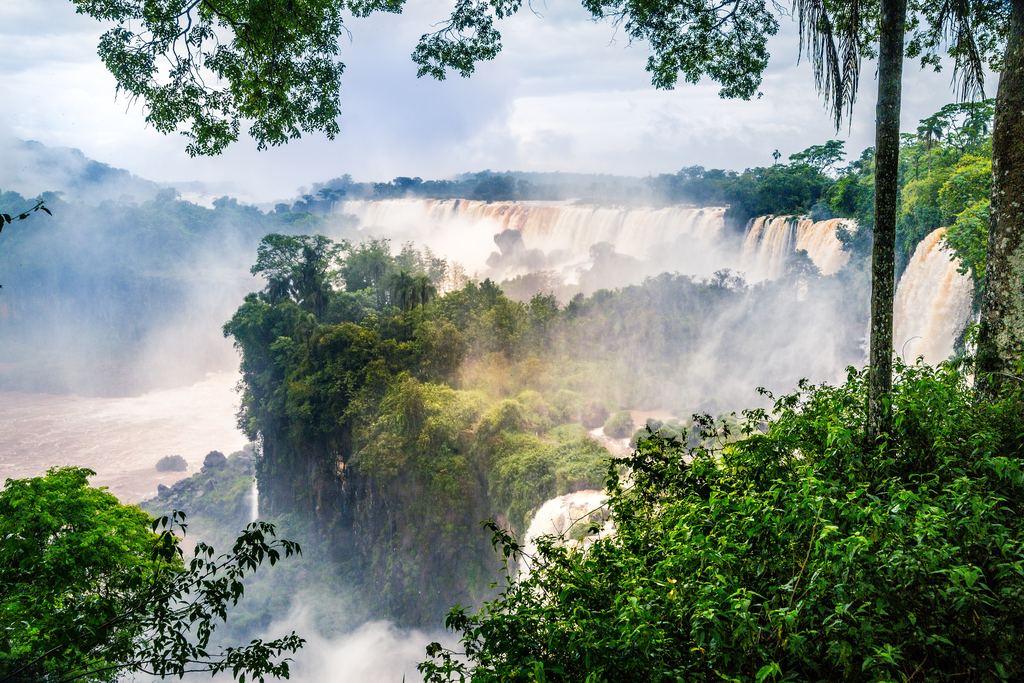
Brown, silt-heavy water and heavy mist are normal in a flood on a river like the Iguaçu. This is a file photo of Iguazú Falls seen through forest trees. It was not taken during the October 2026 flood and it is not evidence of any particular day.
The closure was about the walkway out over the water, not the forest paths. Which of those paths stayed open is the next section.
The closure threshold: 8.5 million or 8 million?
The operator's two pages do not give the same number, and both are worth reading closely. The protocol post of 13 October says that when the flow passes 8.5 million liters per second and shows a rising trend, the walkway is closed as a precaution. The reopening post of 31 October says that, under its operating procedures, the need for a precautionary closure is assessed when the flow reaches 8 million liters per second, again with a rising trend.
These need not contradict each other. One reading is that 8 million is when staff start to evaluate and 8.5 million is when the closure is ordered. The posts do not say that, so it stays a reading and not a fact. The reopening post also says the walkway was closed when the river reached 8.5 million, which matches the protocol. What we can say is what the operator wrote, with the date of each page.
| What the post says | Flow (liters per second) | Post |
|---|---|---|
| Walkway closed as a precaution, with a rising trend | Above 8.5 million | 13 Oct post |
| Walkway railings taken down, with a rising trend | Between 9 and 12 million | 13 Oct post |
| Need for a precautionary closure assessed, with a rising trend | 8 million | 31 Oct post |
| Flow monitored every hour | In high-flow situations | 13 Oct post |
| Reopening needs a technical assessment and an authorization by a specialized engineer | No flow figure we could read unambiguously | 13 Oct post |
The last row is deliberate. The protocol post ties reopening to a flow figure in a sentence we could not read as a clear threshold, so we left the number out. What is clear is the second half: reopening depends on a technical assessment and on an engineer's authorization, which is consistent with the reinstalled guardrails in the 31 October post.
The practical consequence is simple. A closure does not wait for the peak: the walkway closed on 11 October, two weeks before the maximum. And it is the operator's call, by hour, on its own readings. Treat any figure on this page as a description of how the operator says it works, never as a promise that the walkway will be open below a number or closed above it.
What the operator said was open on 26 October
On the peak day the operator listed what was shut and what was not. Closed because of the high flow: the walkway, the Circuito São João, the Espaço Usina and the Caminho do Poço Preto. Closed for works: the Caminho das Bananeiras. Available: the Trilha das Cataratas, the Trilha da Canafístula and the cycle path. It added that the main viewpoints on the Trilha das Cataratas stayed open.
Compare that with the 13 October list, when the flood was still rising. The Trilha da Canafístula was on the closed list then, together with the lower viewpoint at Espaço Naipi, and by 26 October the Canafístula was listed as available. So the list moves, in both directions, within days. A list read in the third week of October does not describe the first week, and neither describes today.
We say this only to explain what the operator published. We are not recommending any path: whether a path is open on the day you arrive is the operator's call and it can change with the river. If a path is marked closed, it is closed.
Where things stand now, and how to check before you go
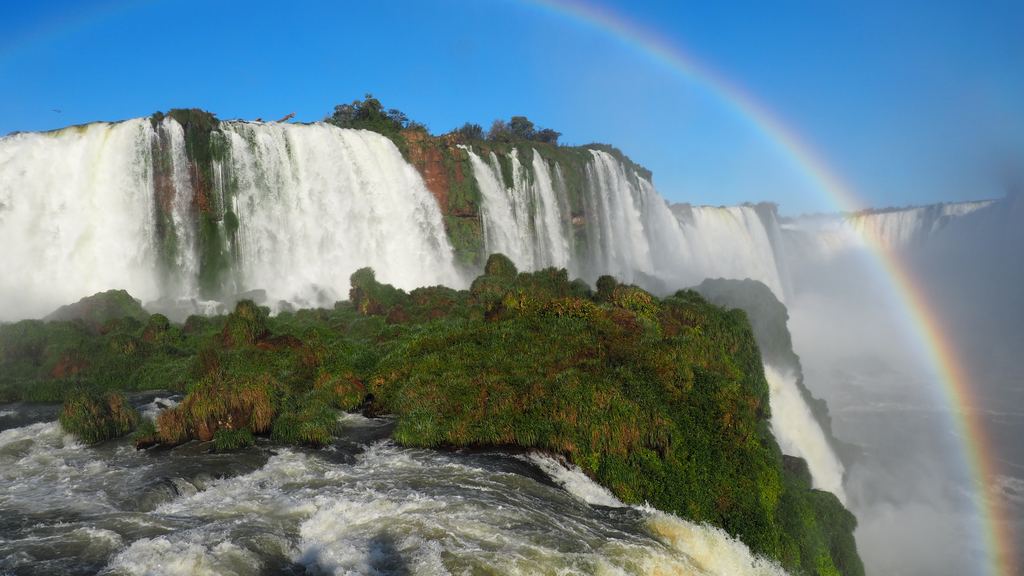
On 12 November the park's news page listed, as its most recent posts about the river, the 31 October reopening and the 26 October peak notice. We found no later closure notice there. That is the absence of a notice on one page on one day, not a live status. A river that took the walkway offline once can do it again, and the page may not be updated before the gates do.
The reopening post also states the park's hours as of 31 October: open every day, Monday to Friday from 9:00 to 16:00 and weekends from 8:30 to 16:00, with an 8:00 opening over the All Souls long weekend, and it recommends buying tickets in advance on the official site. Hours change by season and by holiday, so check the current times when you buy.
For the general routine, see our guide on how to check closures and water levels. If you are comparing ways to see the falls, our Iguazú Falls tour page lists the options that currently exist. We did not read a source for the Argentine side for this piece, so it says nothing about the Argentine park.
Questions about the Iguazú Falls flood and the walkway
Is the Devil's Throat walkway open?
On 12 November 2026 the latest notice on the park's news page was the reopening of 31 October, at 10:00, after a closure from 11 to 30 October. We found no later closure notice, but that is not a live status. Check the official page before you go: the operator can close it again as the river changes.
At what flow does the operator close the walkway?
The operator's pages give two figures. Its protocol post of 13 October says the walkway is closed as a precaution above 8.5 million liters per second with a rising trend. Its reopening post of 31 October says the need for a precautionary closure is assessed at 8 million. Both describe its own procedures, not a rule for visitors.
What did the operator say was open on 26 October 2026?
On the peak day it listed the Trilha das Cataratas with its main viewpoints, the Trilha da Canafístula and the cycle path as available. The walkway, Circuito São João, Espaço Usina and Caminho do Poço Preto were closed because of the flow, and Caminho das Bananeiras was closed for works.
How big is 17.7 million liters per second?
It is about 17,700 cubic meters per second. The operator compares it with a historical average of 1.5 million liters per second and calls it about 11 times that. Our arithmetic gives 11.8 on the peak figure and 10.7 on the roughly 16 million quoted for that Monday morning.
Was this a record flood at Iguazú Falls?
Not confirmed. The operator calls 17.7 million liters per second the largest volume of the year. We did not find an official page on 12 November that calls it a record, and we did not read a long gauge series to test that.
Sources and method
We read the three posts below on 12 November 2026 as raw page text and checked each figure, date and threshold against the Portuguese original. Translations are ours. We also read the park's news index to see whether a later notice existed. We did not read live flow data, and we did not read any source for the Argentine side.
- Passarela reabre para visitação, Urbia+Cataratas, 31 October 2026
- Passarela interditada: entenda o protocolo de segurança, Urbia+Cataratas, 13 October 2026
- Cataratas registram o maior volume do ano, Urbia+Cataratas, 26 October 2026
- News index, Cataratas do Iguaçu, read 12 November 2026
Waterfalls Travel Editorial earns a commission when you book through links on this page. It does not change the price you pay. We are editorially independent of the tour operators; we are paid by commission by the booking platforms we link to. See our editorial policy.
Is the waterfall open on your dates?
How to check closures and water levels before you book anything.
Data verified on . Operator's three posts read 12 Nov 2026; single operator source. Next check: 26 Nov 2026. Editorial Policy