

A tour listing is a form with named fields, and a few of them decide whether the day matches what you pictured. The Viator documentation for its partners names the three that matter most here. Each itinerary stop carries a duration. Each stop carries an admission included flag with three values: yes, no and not applicable. And a stop can be marked as one where the vehicle passes by without stopping, for viewing only. A listing that fills these in is easy to read, and one that leaves them empty is telling you something too. In our own catalog, many listings do not name an entry ticket among their inclusions. A missing line is neither a yes nor a no.
We earn a commission when you book a tour through the links on this site, at no extra cost to you. It does not change what we write: this page also says when a tour is not worth buying. How we are paid is explained in our Editorial Policy.
Three kinds of source sit under this page: the partner documentation, the booking terms of two large platforms, and general observations on our own catalog. Each is named where it is used, with the date we read it.
Where does the tour start, and who collects you?
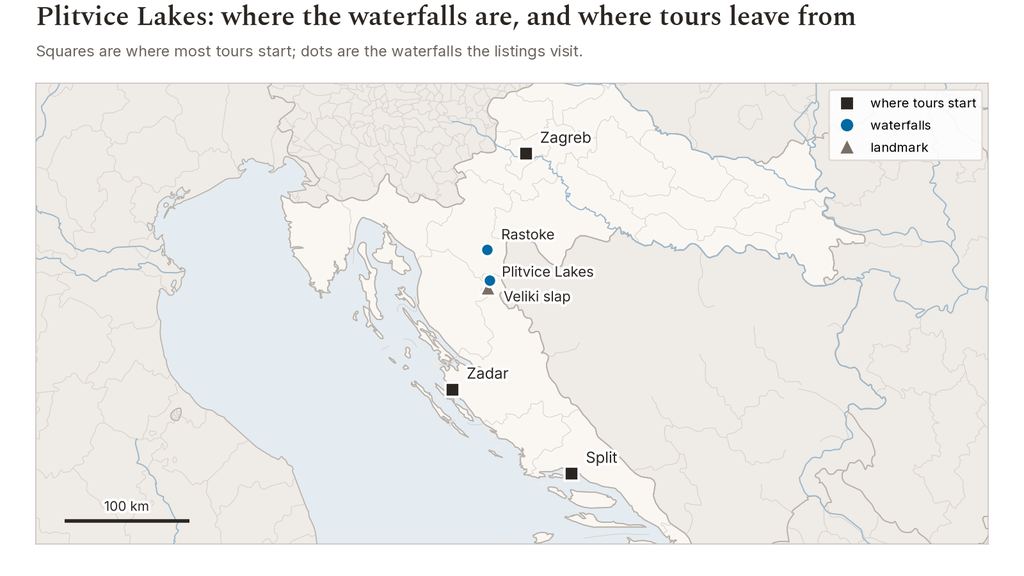
Start with the map, because one waterfall can sit at the end of three different days. Our Plitvice Lakes categories list tours from Zagreb, Zadar and Split. The park is one place, and the drive to it is a different length from each city. What a listing calls the start is a meeting point, a hotel pickup, or both. The Viator documentation says that answer belongs to the product option you select, not to the listing as a whole, so one option can collect everyone at their hotels while the next asks everyone to meet at a set point. Read the option name first.
Booking terms add two details. The Viator terms of use say that for certain products the exact location and time are sent after you book, through its messaging platform, and that checking those messages is your job. If you are not at the meeting point at the required time, the booking can be classed as a no-show, with no refund and no rebooking (section 15.1; we read an archived copy captured 2026-10-16, on 2026-10-27). The GetYourGuide terms let the supplier move the meeting point until 24 hours before the start, as long as the new one is within 15 minutes on foot or by public transport (section 16.4.3, read the same day in an archived copy captured 2026-10-15). The start is a promise with a margin. The margin is written down.
How much of the day is the waterfall?
The length of a listing tells you the day, not the waterfall. A better signal is the itinerary: how many stops it has and how long each one lasts. Many listings give a structured itinerary of stops. Some are built around a single activity, some run for several days, and a few give the itinerary as plain text only, which leaves you nothing to count.
Stop counts and hours vary widely from one listing to the next. A tour with eight stops in four hours is a drive past waterfalls with short halts, while five stops in nearly nine hours leaves a lot of time between them. Neither is wrong. They are different products with the same word in the title, and only the stop list lets you see which one you are looking at before you have paid for it.
The pass-by flag deserves its own look. When a supplier marks a stop that way, the vehicle goes past the place for viewing and nobody gets out. If a waterfall in the title is marked like that, you are buying a window seat. Listing text rarely says so in those words, so read the stop list line by line, and treat a stop with no duration as one you cannot plan around, because nothing on the page says how long you will stand there.
Count the stops, then divide the hours. The waterfall is one share of the day, and the listing should tell you how large.
Is the entry ticket part of the tour?
This is the question a listing answers least often. In the documentation, admission is a per-stop field. In practice, listings differ widely. Some name the ticket outright, others never mention it, and the habit changes from one destination to the next. Silence is not a yes.
| Where to look | What to look for | What a gap means |
|---|---|---|
| Inclusions | The words admission, entrance, entry or ticket, and which sites they cover | A question for the operator, not a no |
| Exclusions | A ticket listed as paid on the day or bought by you | The listing does not cover the whole day |
| Itinerary stops | The admission flag on each stop: yes, no or not applicable | Not applicable is not the same as included |
| Notes at the bottom | Park charges, permits, or a note that the ticket must be bought apart | Ask in writing and keep the answer |
A listing that never mentions a ticket does not prove that nothing is charged on the day. It shows that the inclusion list is silent about tickets, and a silent line is a question for the operator before you pay. To practice, open a few listings in Ubud, La Fortuna, Damajagua, Ourika Valley, the Columbia River Gorge and the South Coast, and look for the ticket in the three places it can hide: inclusions, exclusions and the notes at the bottom. We have not read every listing one by one, and you should not assume we have.

Who else is on the tour, and in what language?
Two more fields set the feel of the day. The first is whether the tour is private, which the documentation defines as true when only the travelers who booked will be present. Many listings in our catalog carry the provider's private flag. A private tour is a different product, not a better version of the shared one, and for shared tours the documentation gives a maximum group size, when the supplier fills it in, so look for that number before you assume the group will be small.
The second is language. Many listings include English among their languages, but not all do. The documentation attaches the language list to each product option, which means the shared option and the private option of one listing can offer different guides. Pick the option, then read its languages.
Does booking confirm the tour on the spot?
Usually it does. The documentation describes three confirmation types: instant, manual, and instant-then-manual. Instant is the common case, but some products are manual and some switch from instant to manual. For those, a person at the supplier has the last word. The switching ones follow a simple pattern in the documentation's own example: a product confirms instantly when booked more than 48 hours ahead and goes to manual confirmation inside that window. If you book a few days before a trip, a manual product can sit in a pending state while your plans harden around it.
What does the cancellation line really say?
The cancellation line is the one most readers skim and the one platforms write most carefully. The Viator documentation sorts policies into three categories: standard, custom and all sales final. The Viator terms of use say the standard policy lets you cancel up to 24 hours before the start, or, when a product has no explicit start time, until the end of the day two days before. They add that a minority of products have different policies and that you must check the one in the listing at the time of booking (sections 15.2 and 15.3, archived copy captured 2026-10-16, read 2026-10-27). No refund is available once an experience has started (section 15.7).
GetYourGuide's terms use the same 24-hour line as a default: full refund beyond it, none inside it or for a no-show, unless the activity description says otherwise (section 10.4, archived copy captured 2026-10-15). They also say that when external circumstances such as adverse weather make an activity impossible or dangerous, the supplier may cancel without observing the standard period and the money paid for the booking is refunded (section 16.4.1). The Viator terms we read have no matching clause. Their liability section says Viator will make no refund for a cancellation caused by force majeure or other causes beyond its direct control, and it does not describe what a supplier owes you if it calls off a day for weather. We could not open either platform's help pages, so those remain unread. Treat all of this as two examples of a default, with 24 hours as the pattern and the listing as the authority. Read the listing's own line.
| Platform | Default window | What can override it | Section |
|---|---|---|---|
| Viator | Cancel up to 24 hours before the start | A listing marked all sales final, or a custom policy stated in the listing | 15.2 and 15.3 |
| GetYourGuide | Full refund beyond 24 hours, none inside it or for a no-show | Conditions in the activity description, or a supplier cancellation for external circumstances | 10.4 and 16.4.1 |
For a day built around water, weather deserves a question before you book. If the waterfall is closed or dry covers what to do when the site itself changes, and it is worth reading beside the cancellation line.
What does a listing leave out?
Here is the uncomfortable part. We publish tours whose listings are silent on the points above, and we cannot audit each of them. Some have a text-only itinerary, so a stop count is impossible. Many do not name an entry ticket. And the length of a listing, which is the number most readers compare first, says almost nothing about the time at the waterfall. A listing can be honest and still leave you guessing, and when it does, the useful move is to ask the operator before booking, in writing, and to keep the answer where you can find it on the day of the trip.
A two-minute check before you pay
- Name the product option you are booking and read its pickup or meeting-point line.
- Count the stops in the itinerary and note any that pass by without stopping.
- Find the entry ticket under inclusions, under exclusions, or note that it appears nowhere.
- Decide between private and shared, and look for the maximum group size.
- Read the languages of the option you picked.
- See whether booking confirms instantly.
- Read the cancellation line and note whether the listing states its own terms.
Our guide to if you need a tour at all covers the step before this one, and the formats of waterfall tours explains what kind of day you are looking at. Both sit in Plan Your Waterfall Trip.
Quick answers
What does skip the line mean in a listing?
The Viator documentation defines the flag as true when a ticket for the product allows participants to attend a location without having to obtain a separate ticket on the occasion itself. It describes access to a location. It does not say whether every stop is covered, so read the admission line for each stop.
Is hotel pickup the same as a meeting point?
No. The documentation treats them as different options: pickup for everyone, pickup plus a meeting point, or a meeting point only. The rule belongs to the product option, so two options of one listing can differ.
Who do I ask when the listing is silent?
Ask the operator named on the listing, through the booking platform's messaging, and keep the reply. The platform terms we read say that the policy in the listing governs your booking.
Does a long tour mean more time at the waterfall?
Not necessarily. A tour with eight stops in four hours is mostly a drive with short halts, while one with five stops in nearly nine hours leaves long gaps between them. Count the stops and read each duration.
Data verified on . Documentation and terms read on 2026-10-27 (terms from archived copies of 2026-10-15 and 2026-10-16). Remarks about our catalog are general impressions, not counts. Check the listing. Editorial Policy
See how an Ubud listing answers these questions
We earn a commission if you book through this link. Read each listing's entry ticket and cancellation lines before you pay.