
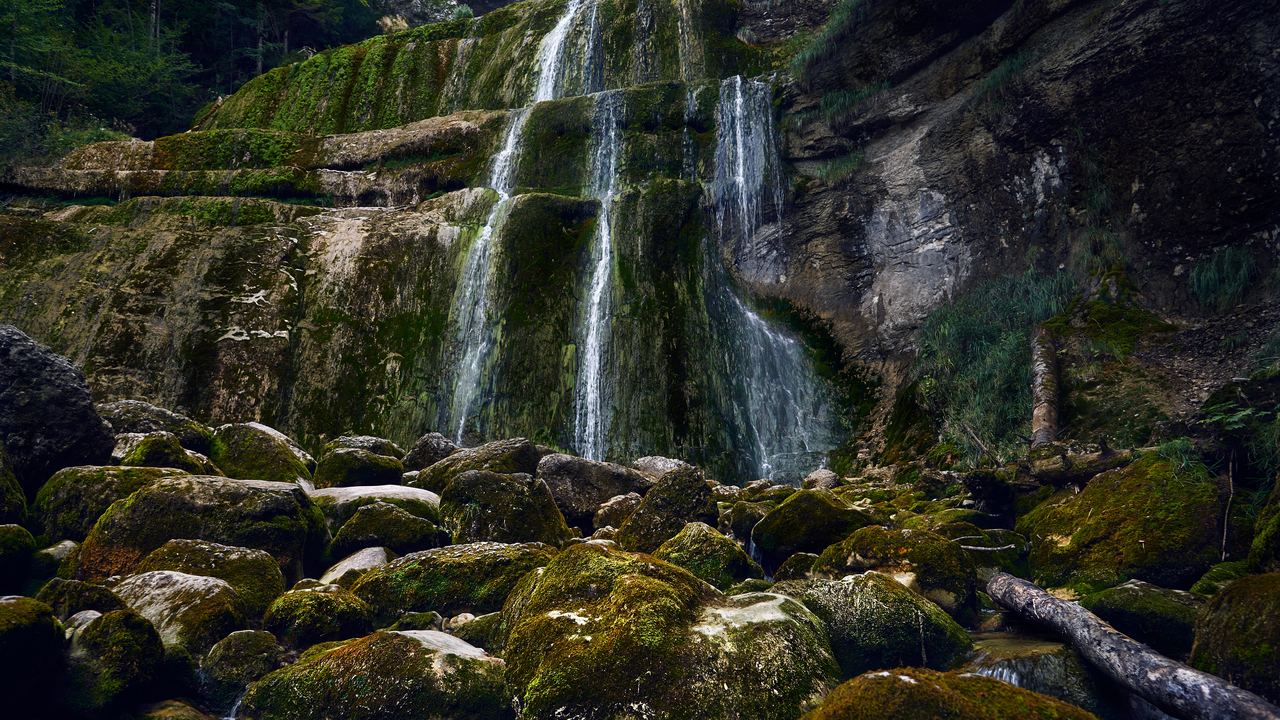
A tufa waterfall is built by the water that falls over it. Calcium carbonate leaves the river, settles on moss and algae, and hardens into a barrier that keeps growing. Most waterfalls do the reverse and wear back upstream. In his 2020 review of waterfall science, Andrew Goudie credits the term constructive waterfalls to J. W. Gregory, in a 1911 paper. Goudie lists the Krka falls in Dalmatia and Dunn's River in Jamaica among the falls that advance instead of retreating. This guide stays with what two Croatian national parks and a handful of papers say about that, and it flags the places where they disagree.
We earn a commission when you book a tour through the links on this site, at no extra cost to you. It does not change what we write here. How we are paid is explained in our Editorial Policy.
Is tufa the same thing as travertine?
Not in every source. One kind of rock gets two names, and the names do not line up from one text to the next.
| Source | Word it uses | What it describes |
|---|---|---|
| Plitvice Lakes National Park | Tufa, and also travertine barriers | A hollow, porous rock made when plants, algae and mosses help calcium carbonate drop out of the water |
| Krka National Park | Tufa, which the park says is also called travertine | Calcium carbonate that settles out of running water onto different surfaces |
| World Waterfall Database glossary | Travertine | A deposit of limestone formed in caves and around hot springs |
| UNESCO, Pamukkale (Turkey) | Travertine | White terraces beside thermal springs |
| UNESCO, Huanglong (China) | Travertine | Pools, lakes and waterfalls in a mountain valley |
The Plitvice park defines tufa in one sentence and then, a few paragraphs later, captions its Upper Lakes barriers as travertine. Krka says outright that tufa is also called travertine. The World Waterfall Database keeps travertine for caves and hot springs, and UNESCO's text for Pamukkale fits that, since the terraces there sit beside thermal springs, while its text for Huanglong uses the same word for a valley of lakes and falls. Even a geologist is loose with it. Maurice Tucker, writing for the Bath Geological Society, titles his note on Welsh stream crusts tufa-travertine deposits and says the crusts are identical to those of hot-spring travertine.
Here we use tufa for the cold-water deposit built on moss and algae, the kind at Plitvice and Krka. When a source says travertine, we keep its word and say whose it is.
When a listing promises travertine, ask which kind. Hot-spring terraces in Turkey and cold-water river barriers in Croatia are both calcium carbonate, and they are managed very differently.
How does a river build its own waterfall?
Both Croatian parks give the same chemistry, in almost the same words. The water has to be oversaturated with calcium carbonate, its pH has to be above 8, and dissolved organic carbon has to stay below 10 mg per liter. Krka's tufa page adds that deposition speeds up in warmer water and where the current runs between 0.5 and 3.5 meters per second. Those numbers describe a river that is clear, hard and moving. A muddy or acidic river does not build anything.
The physical half is turbulence. Tucker's note says degassing of carbon dioxide from stirred-up water is a major cause of calcite precipitation, and that microbes, mainly cyanobacteria, remove more carbon dioxide by photosynthesis. A waterfall is the most turbulent place on a river. That is why the deposit piles up there, and why the Plitvice park stresses the living layer: cyanobacteria, diatoms and bacteria on the rock and on the mosses, which it calls the living community on the rock.
Where does the tufa grow fastest?
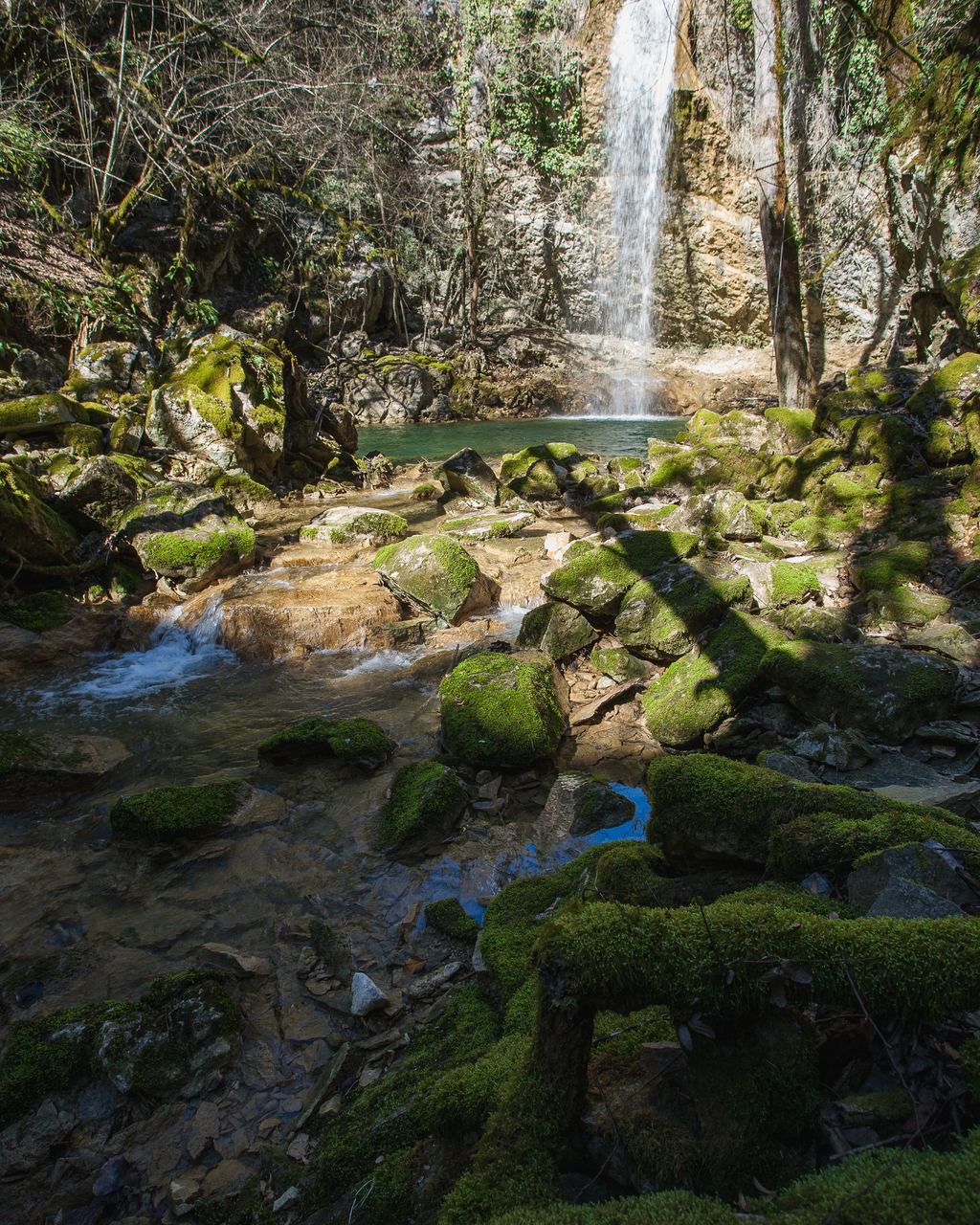
Krka National Park tested that in 2024. Its summary of the study at Skradinski buk compared five zones. Formation was strongest on sunlit barriers and falls with strong flow, where moss communities dominate, chiefly Palustriella commutata and Didymodon tophaceus. The deposits there were extremely porous and layered. Shaded forest cascades at the top of the falls did worse: less light, weaker flow, more cyanobacteria and fewer mosses, and a deposit that was denser but laid down more slowly. Side tributaries and the riverbed below the falls were the least active zones.
The practical reading is simple. A tufa waterfall is not one thing growing evenly. It is a set of bright, fast, mossy faces that add rock, and quieter corners that barely do.
What shapes does tufa take on a waterfall?
Krka's tufa page names the forms. Underwater covers, sills and barriers sit at the base of karst rapids. Curtains and consoles form where water pours down a vertical rock face. Ridges, grooves and pipes appear where a large volume of water cascades. The park's geology page adds cones and says the youngest formations are the thresholds hidden under the surface. If you have walked a boardwalk at Skradinski buk and wondered why the cliff looks like a hanging garden, that is the answer: the rock was grown on a frame of moss.
At Plitvice the park says moss is the most common cover on the steep and sometimes vertical barriers, and that Palustriella commutata is the species that most often takes part in building tufa. It is, in the park's words, quickly petrified, and the shape of the moss survives inside the rock. In calmer water a second moss, Ptychostomum pseudotriquetrum, builds a softer type the park calls Brijum. Krka's moss list is partly different, so do not merge the two. Each park names its own.
Tufa falls are not always small. Goudie's review mentions a tufa cascade at Blasskrantz in Namibia's Naukluft area that is about 80 m high and 400 m wide. That is the review's figure for that single cascade, and it sits in a dry country. Which is why it is worth mentioning: tufa needs carbonate-rich water, not a wet climate.
How fast does tufa grow, and which number can you trust?
Every figure belongs to one barrier and one method. Treat each as local. The Plitvice park page on age and growth gives several, and the table puts them side by side with what each one measures, while the Krka rows come from the park's geology page.
| Figure | What it measures | Who says it | Caution |
|---|---|---|---|
| About 13.5 mm | Growth of the tufa barriers, set against lake sediment that the park says is deposited about 17 times more slowly | Plitvice Lakes National Park | The sentence gives no time unit |
| About 5.6 mm a year | Growth of the exit barrier of Kozjak Lake, from recent hydrological methods | Plitvice Lakes National Park | One barrier, one method |
| Three times that rate | Growth of the barrier at Prošćansko jezero | Plitvice Lakes National Park | Stated relative to Kozjak, not as a number |
| 6,000 to 7,000 years | Estimated age of the barriers that are active today | Plitvice Lakes National Park | An estimate tied to the end of the last Ice Age |
| 250,000 to 300,000 and 90,000 to 130,000 years | Dated paleobarriers found at higher elevations beside the watercourses | Plitvice Lakes National Park | Older tufa that grew in earlier warm periods |
| Less than 10,000 years | Age of most of the travertine at the Krka waterfalls | Krka National Park | Krka writes travertine here |
| Up to 20 m above today's bed | Where Pleistocene fossil travertine sits in the Krka valley | Krka National Park | Shows an old water level, not a growth rate |
The first two Plitvice numbers differ by a factor of about 2.4 (13.5 against 5.6, our arithmetic), and the park does not reconcile them in the text we read. One comes from the ages of barriers and sediments, the other from hydrological methods applied recently. The park adds that each barrier has its own growth dynamics. Sometimes a downstream barrier outgrows the one above it, drowns it, and two separate lakes become one.
The uncomfortable part is scale. At 5.6 mm a year a barrier gains about 56 centimeters in a century, and nobody at the railing sees that. Calling a waterfall "still growing" is true and invisible. You come for the moss, the water and the light, not to watch rock being made, and a listing that promises the second is selling a poster.
Do tufa waterfalls retreat like Niagara?
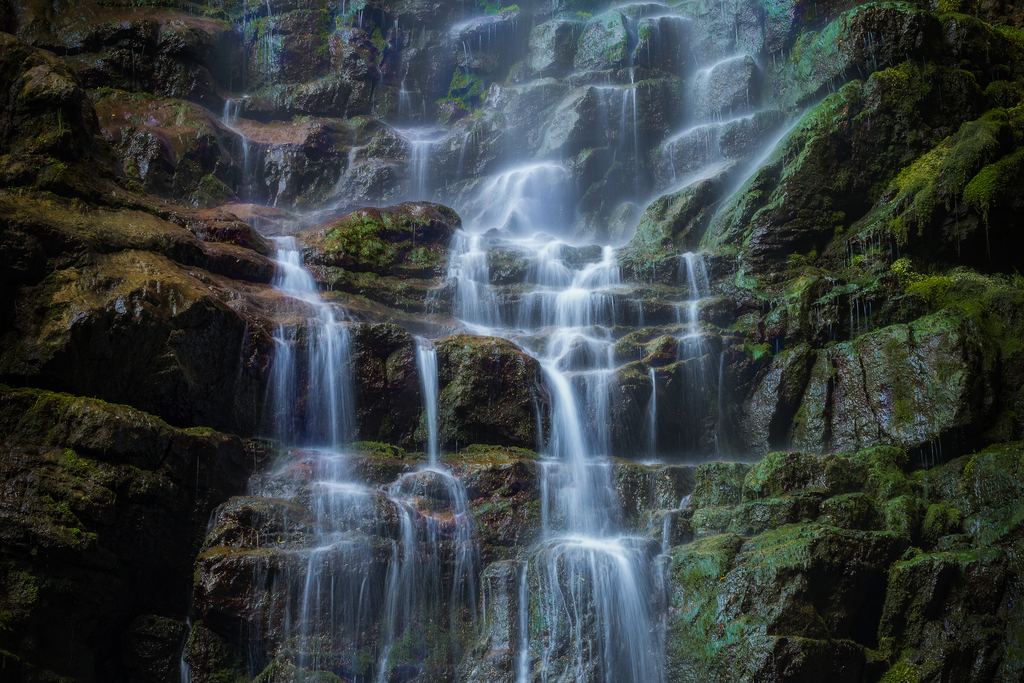
Mostly not. Goudie's review says that for ordinary waterfalls the characteristic recession rate is a few tens of millimeters per year, with a great spread between sites, and that is erosion: the lip wears away and the fall moves upstream, as it does at Niagara (see our guide to Niagara erosion and the 1950 treaty). A tufa fall can add material at the lip instead. Rock lost, rock gained. Our guide to how waterfalls form covers the ordinary case, and the two should not be compared rate against rate, because they use different methods.
What are you allowed to do on a tufa barrier?
The rules point both ways. Krka's park rules list moving along tufa barriers outside the marked trails among the things that are not allowed, and Plitvice's rules of conduct tell visitors not to walk outside the marked footpaths. At Pamukkale, UNESCO's text says visitor access to the travertine terraces is prohibited to sustain the water flow and to protect how the terraces look and are built. Dunn's River is the opposite case. The operator's own climb page sells climbing the falls as the main activity and says the falls were created by the flow of the water.
Swimming is a separate rule set. Plitvice bans it, and Krka allows it only in marked areas; our guides to swimming at waterfalls and to choosing between the two Croatian parks cover those rules. Krka's own study summary lists the lake below the main fall at Skradinski buk as a former swimming area and says nothing about why. We read no reason on any of these pages and we do not supply one.
Where can you see tufa waterfalls on this site?
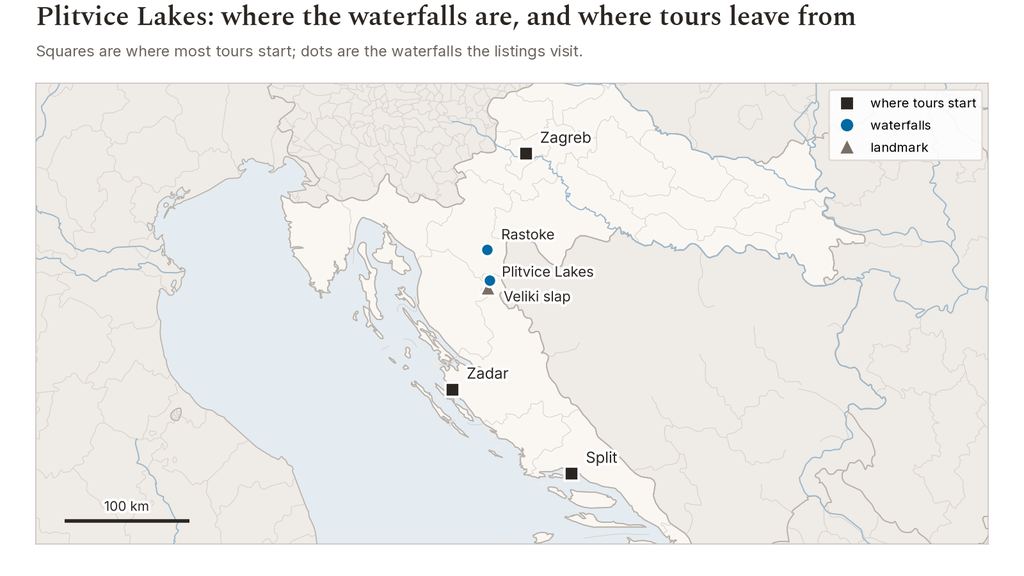
Start in Croatia. Our catalog has tufa at Plitvice Lakes and Krka National Park, and at Dunn's River, which sits on the Ocho Rios page. Wikipedia describes the Kravica falls on the Trebižat river, which we list on the Kravica page, as a tufa waterfall, but we did not find an operator page that says so, so we add nothing about Kravica here. If you are choosing how to book, read how to choose a waterfall tour first and then our note on where to go.
Quick answers on tufa
Why are tufa waterfalls so green?
Moss does the building. The Plitvice park says moss is the most common cover on its steep barriers and that the rock forms around it, so the green you see is the living frame of the barrier. In shaded zones at Krka, cyanobacteria take over from moss and the deposit is denser.
Does a tufa waterfall grow every year?
The Plitvice park gives about 5.6 mm a year for one barrier, and says other barriers grow faster or slower. Krka's study found the fastest formation on sunlit, fast-flowing faces. Read the figures as local and approximate.
Can I walk on the terraces at Pamukkale?
UNESCO's text says visitor access to the travertine terraces is prohibited to protect the water flow and the look and structure of the terraces, and that bathing areas for the hot springs are set apart. Read on 2026-10-27 through the Internet Archive; check the site's own rules before you go.
Is Skradinski buk really the longest tufa barrier in Europe?
That is Krka National Park's own statement and the park gives no metric for it. We repeat it as the park's claim and not as a measured ranking.
Data verified on . Read on 2026-10-27 from the parks' own pages, UNESCO via the Internet Archive, Goudie 2020 and Tucker 2015. Growth figures are local. Editorial Policy
Plitvice Lakes, the tufa you can walk through
We earn a commission if you book through this link. The park's own rules on trails and swimming apply on every tour, so read them first.