
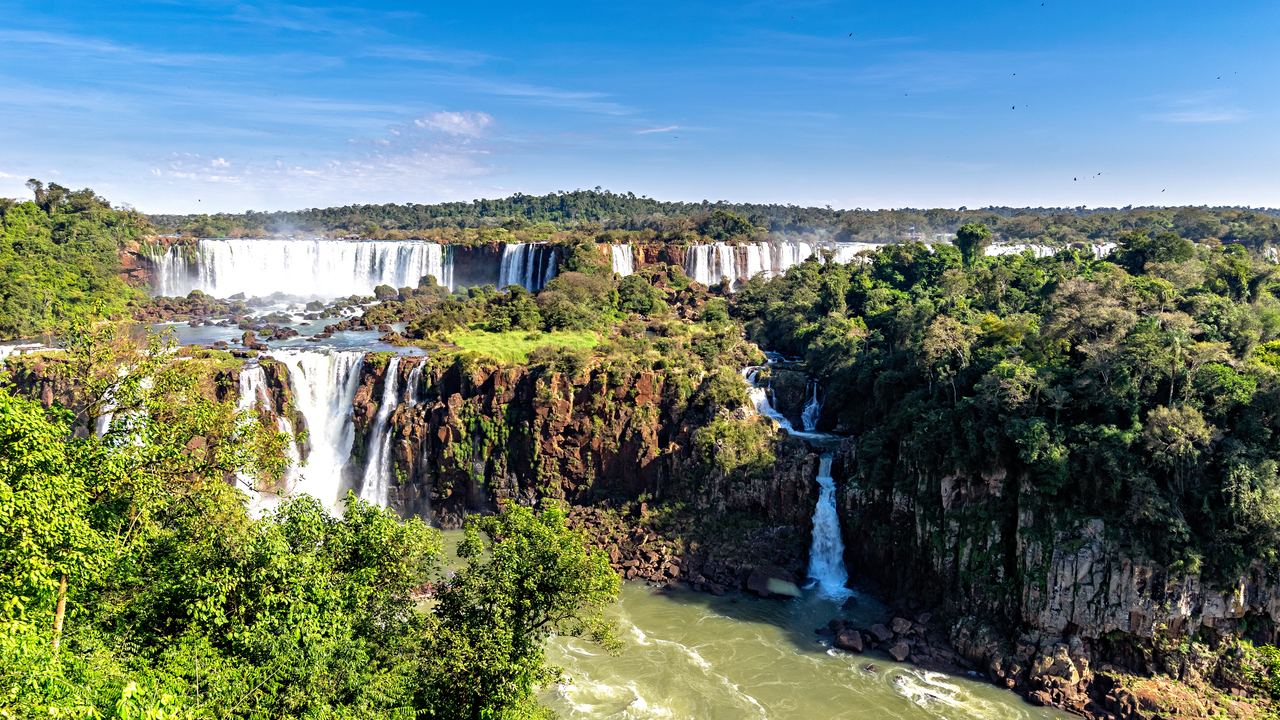
Most waterfall questions have a one-sentence answer and a catch. This page gives the sentence, names who said it, and sends you to the guide where the catch gets its room. Where a number depends on a list or on who measured it, the answer says so. If you are picking a tour rather than a fact, start with how to choose a waterfall tour; the background sits under how waterfalls form.
We left out health, drinking water and dangerous animals. No source we read answers them well enough to repeat, and a missing answer is cheaper than a wrong one.
We earn a commission when you book a tour through the links to our Plitvice Lakes, Niagara Falls and Victoria Falls pages, at no extra cost to you. It changes none of the answers below. How we are paid is explained in our Editorial Policy.
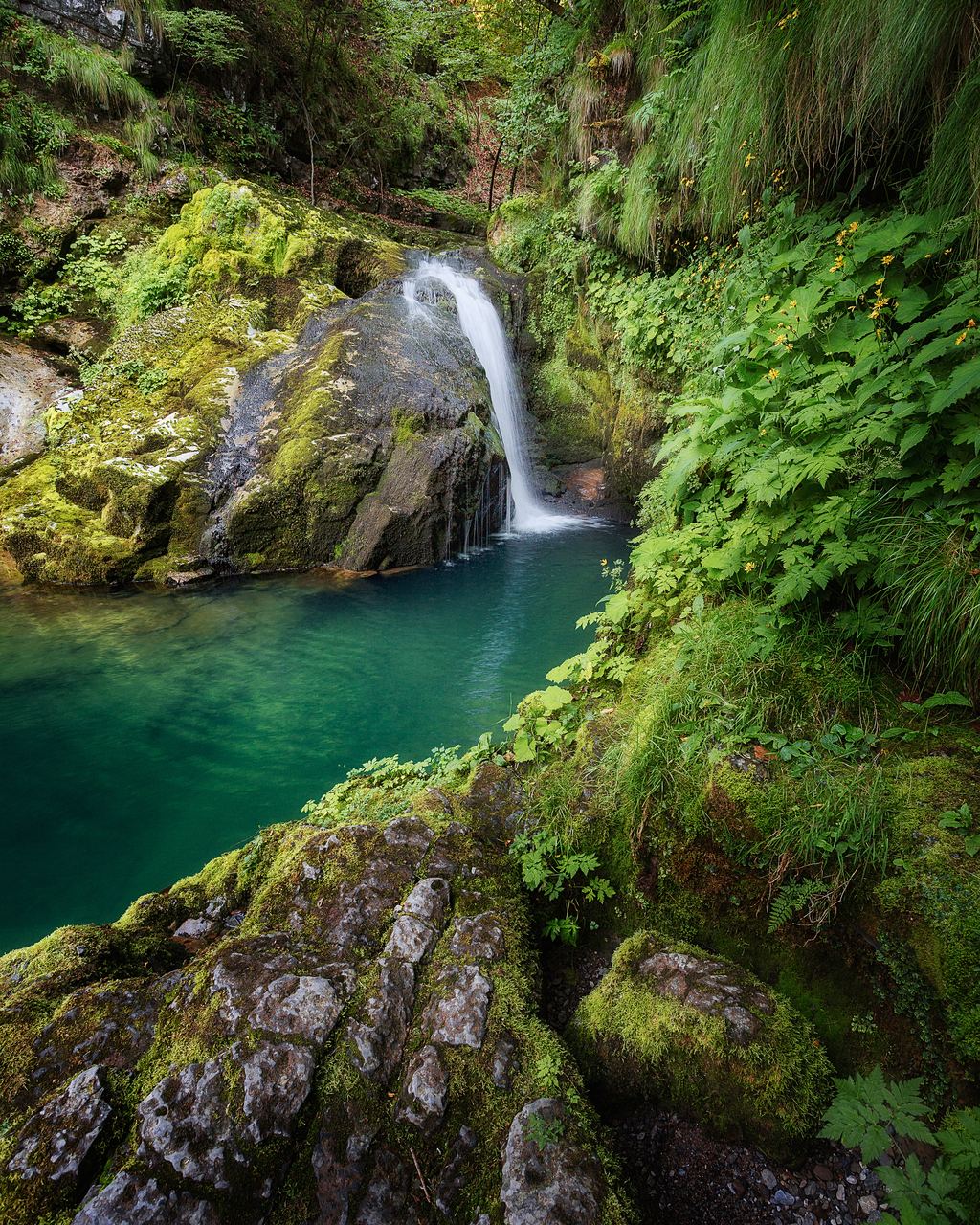
Where do the answers come from?
Each answer takes one fact from one of our guides. Those guides read an operator's page, a park, an agency or a paper on 2026-10-27 and name the source in the sentence that uses it, which is why most answers below say who is speaking. Nothing here is a ranking. Nothing is a forecast.
Where a number depends on a list, the answer gives the list too, and where a claim belongs to one operator, the answer says whose. When two sources disagree, you get both.
Twenty-two short answers
How old is the survey behind Angel Falls' height?
Guinness dates the last survey of Angel Falls to 1949, a National Geographic expedition, and adds that it is debated whether the full 979 m is a single fall. Both figures are in the Guinness entry and in our guide to waterfall records.
Who claims the European title, Dettifoss or the Rhine Falls?
Both do, on different measures. The Rhine Falls site says Europe's largest and gives 150 m of width, while the Vatnajökull National Park page calls Dettifoss the most powerful in Europe. The two claims sit side by side in records by metric.
Is the flow of Iguazú 1,746 or 11,800 cubic meters a second?
Both numbers exist. The database's average high volume is 1,746, and the Brazilian concessionaire posted 11,800 for 12 October 2026, one day's reading. What an operator does when the river rises is in our page on closed or dry falls.
Where does tufa grow fastest at Krka?
In its 2024 study at Skradinski buk, Krka National Park saw the most tufa form on sunny, fast-flowing faces with moss, and the least in side streams and the riverbed under the falls. The rest of the study is in our tufa guide.
How old are the tufa barriers at Plitvice?
The park puts the age of today's active barriers at 6,000 to 7,000 years, and older paleobarriers higher in the valley at far more; the tufa and travertine guide sets out in a table.
Does a tufa waterfall have to be small?
No. Goudie's 2020 review describes a tufa cascade at Blasskrantz, in Namibia, roughly 80 m tall and 400 m across, in a dry region. What tufa needs is carbonate in the water, not rain; see tufa and travertine waterfalls.
What shapes does tufa take on a waterfall?
Krka's tufa page lists sills and barriers at the foot of rapids, curtains and consoles on vertical rock, and ridges, grooves and pipes under heavy cascades. Moss supplies the frame for all of them, as the tufa guide explains.
Is Niagara's water reduced after dark?
No source we read says so. The 1950 treaty sets minimum flows, one for tourist hours and a lower one at any other time, and nobody publishes the hourly flow, so the Niagara guide quotes none.
Who watches Niagara's minimum flow?
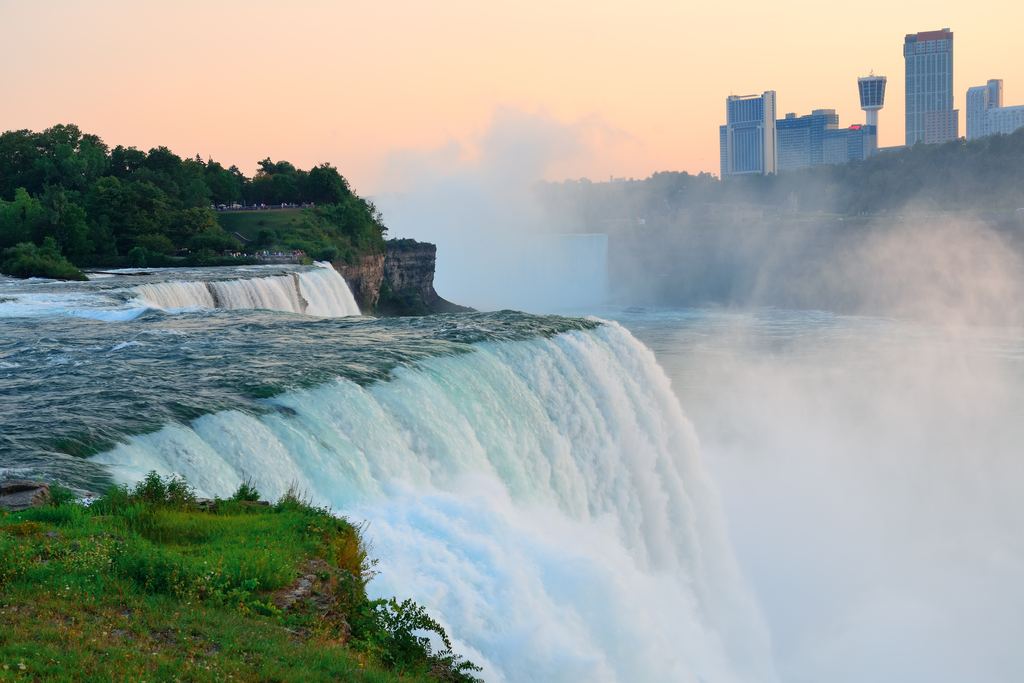
Representatives of both countries, designated the International Niagara Committee in 1955, inspect the flows weekly, according to the IJC. Eighteen sluice gates upstream of the Horseshoe Falls make the minimum possible; the Niagara guide names them.
How did anyone measure Niagara's retreat?
By comparing crest surveys, one finished in 1842 and one made by W. Carvel Hall in 1905. G. K. Gilbert set them against each other and got 5 feet a year for the Horseshoe; his working is summarized in Niagara erosion and the treaty.
What is Niagara's retreat rate now?
The IJC's Niagara Board gives about 0.1 meter a year. A 2009 paper that cites the same figure says no certain record of recent retreat exists, so read it as an estimate; the erosion section lines up every source.
Has the Horseshoe crest got longer?
Yes. Hayakawa and Matsukura's 2009 paper puts it at 420 m in 1842 and 762 m in 2000, and the IJC says a horseshoe shape tends to slow erosion. The numbers are in the Niagara guide.
Do waterfall spray zones hold more species?
In a British Columbia survey of six waterfalls around Wells Gray, the spray zones turned up 994 species against 624 at comparison sites. Ferns and other vascular plants frequently did better away from the water, which the wildlife guide covers.
When can you watch salmon at Salmon Cascades?
At Salmon Cascades in Olympic National Park, the Park Service points to coho in September and October and steelhead in spring, late March to May. Our wildlife guide found dates for no other waterfall.
How does a dipper reach a nest behind falling water?
The nest entrance faces the water, and Rocky Mountain National Park says the bird can fly through waterfalls. Cornell treats a nest behind one as an unusual choice, as the wildlife guide notes.
Is there a forest in the spray at Victoria Falls?
UNESCO places a riverine rainforest on sandy alluvium within the splash zone and names the gorges as nesting ground for four endangered or migratory bird species. We found no open list of the animals living in the mist; see waterfall wildlife and plants.
How far away can the Victoria Falls spray be seen?
UNESCO gives the plume as roughly 500 m tall at its highest, and says it shows from 50 km away on the Bulawayo road and 30 km on the Lusaka road. Tours are listed on our Victoria Falls page.
How many routes does Plitvice offer, seven or eight?
The park's own pages carry both: seven on the general information page and eight on the activities page, while the lake tour program lists eight. Plan from the program page, and see Krka or Plitvice for the rest of the comparison.
How many entrances does Krka have?
Four on the park's entrances page and ten in the footer that appears across its site, and we do not know what the ten counts. If the difference decides your day, ask the park, and read the Krka and Plitvice comparison first.
How long are the walks on the Argentine side of Iguazú?
The park's activities page gives 1,750 m for the lower circuit, 1,850 m one way for the upper circuit and 1,100 m for the walkway to the Garganta del Diablo. The border falls guide sets them beside what the Brazilian bank publishes.
What is a segmented waterfall?
The word has two meanings. The Park Service applies it to drops in succession, such as Ranger Falls at 172 feet in three segments, while the World Waterfall Database applies it to streams falling side by side. The glossary of waterfall types lists the other splits.
What is Mabin's test for a true waterfall?
Goudie cites the geomorphologist Mabin for a stricter definition: a near-vertical drop with a clear lip, where the lip sits no farther from the plunge pool than about 25% of the fall's height. The other definitions are in the glossary.
Which dates did we check against official pages?
These are eight dates that tourism pages repeat, checked on 2026-10-27 against the body that issued each one. The Plitvice park gives its two on a history page, Krka gives its own on the park's about page, and the treaty date comes from the International Joint Commission's treaty FAQ. UNESCO's site returned a 403. So the World Heritage years were read in copies the Internet Archive saved in October 2026, for the lists of Plitvice, Iguazú in Argentina, Iguaçu in Brazil, Victoria Falls and Canaima. Dates we could read only on secondary pages, such as the first tightrope crossing and the first barrel ride at Niagara, are not in the table.
| Event | Date | Where it is stated |
|---|---|---|
| Plitvice Lakes declared Croatia's first national park | April 8, 1949 | Plitvice Lakes National Park, history page |
| Plitvice Lakes inscribed on the World Heritage List | October 26, 1979 | Park history page for the day, UNESCO list entry 98 for the year |
| Niagara Treaty signed by the United States and Canada | February 27, 1950 | International Joint Commission, treaty FAQ |
| Krka proclaimed a national park, covering 142 km2 | January 24, 1985 | Krka National Park, about page |
| Iguazú National Park in Argentina inscribed | 1984 | UNESCO list entry 303 |
| Iguaçu National Park in Brazil inscribed | 1986 | UNESCO list entry 355 |
| Mosi-oa-Tunya / Victoria Falls inscribed | 1989 | UNESCO list entry 509 |
| Canaima National Park in Venezuela inscribed | 1994 | UNESCO list entry 701 |
Every date in this table is an administrative act: a law, a signature, an inscription. None of them is the age of a waterfall.
What does a date not tell you?
Three things the table cannot say. The Krka park proclaimed on January 24, 1985 covered 142 km2, while the park's about page today gives 109 km2, so the date belongs to a larger area than the one visitors walk. Mosi-oa-Tunya / Victoria Falls is a transboundary property with national parks of both Zambia and Zimbabwe inside it, so 1989 is one inscription and not one per bank. Iguazú is the opposite case: 1984 for the Argentine park and 1986 for the Brazilian one, two inscriptions for one river.
Dates mislead in quiet ways. The UNESCO entry for Canaima, the park that holds Angel Falls, does not name the falls in the text we read.
Is the Victoria Falls moonbow predictable?
A Kentucky site says yes. The marker text on ExploreKYHistory, a history site of the state of Kentucky, says the moonbow at Cumberland Falls appears on a fairly predictable schedule and that the only other predictable moonbow occurs at Victoria Falls in Zimbabwe. For Cumberland it gives the window as two days before, on or after a full moon, strongest when the moon is lowest between dusk and midnight, and it lists water temperature, rising mist, clear skies, water clarity and wind as conditions that must come together.
The claim about Victoria Falls is the marker's, and it is the only source we read for it. We did not check it against a Zimbabwean or Zambian operator, and the marker gives no dates, so there is no moon calendar here.
Where each answer is explained at length
Waterfall records by metric
Height, width and flow, each with its list and its source.
Niagara: erosion and the 1950 treaty
The minimum flows, who keeps them and how fast the crest moves.
Tufa and travertine waterfalls
How rivers build their own falls, and what the parks measured.
Waterfall wildlife and plants
Birds, fish and spray-zone plants, with the caveat beside each.
Types of waterfalls: a glossary
Thirteen terms, and the places where sources disagree.
Krka or Plitvice?
Two Croatian parks compared, page against page.
Data verified on . Dates read 2026-10-27 on the issuing bodies' pages; UNESCO through Internet Archive copies. Check the official site before you go. Editorial Policy
Plitvice Lakes, where the 1949 date comes from
We earn a commission if you book through this link. The park's own rules apply on every tour.