
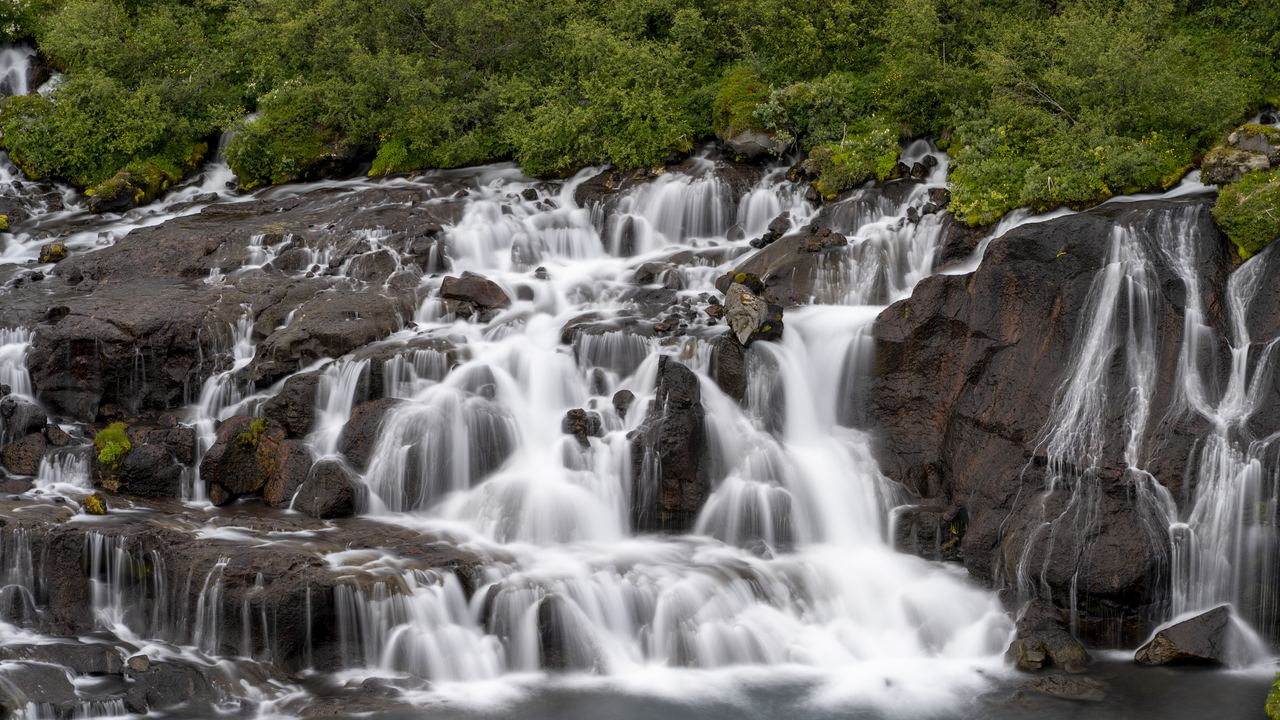
The National Park Service calls Ranger Falls in Mount Rainier National Park a 3-segmented waterfall: several drops in succession, 172 feet in total, the tallest of them 73. The World Waterfall Database uses the word segmented for something else, streams that fall side by side. Neither source is wrong. That is the whole difficulty with waterfall vocabulary.
National Geographic Education says there is no standard way to classify waterfalls, and that most of them fit more than one category. This glossary gives 13 terms, each with the source we are using, and flags the places where sources disagree. We read the National Geographic Education entry on waterfalls, Andrew Goudie's 2020 review of waterfall forms in Quaestiones Geographicae, the Mount Rainier National Park waterfall list, the Plitvice Lakes tufa page and the World Waterfall Database glossary on 2026-10-27. The database text is copyrighted, so we paraphrase it and quote only a few words.
We earn a commission when you book a tour through the links to our Plitvice Lakes, Niagara Falls and Iguazú Falls pages that appear below as examples. What you pay stays the same, and it does not change a definition. How we are paid is explained in our Editorial Policy.
Plunge or horsetail: does the water touch the rock?
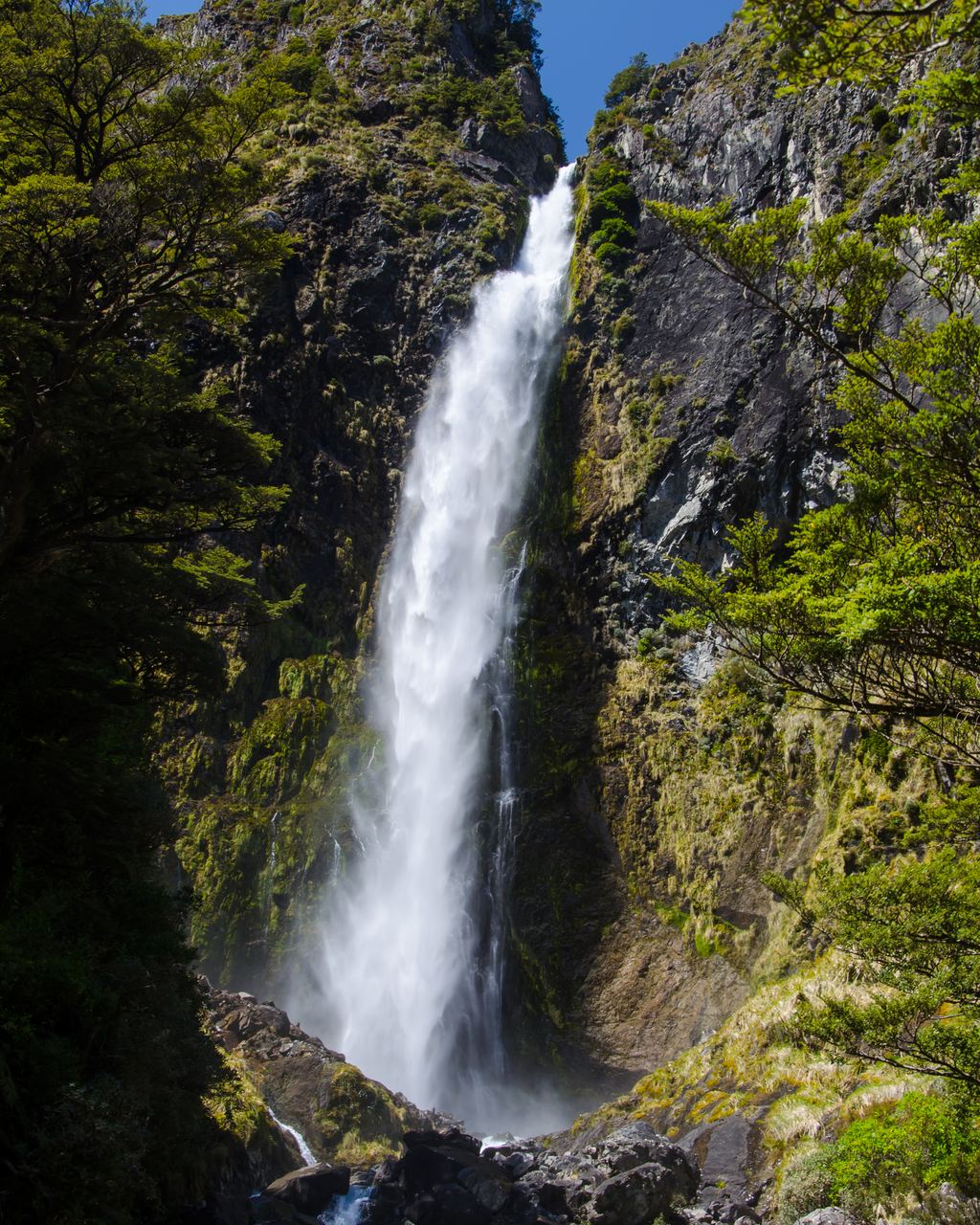
National Geographic Education separates the two by contact. A horsetail waterfall keeps touching the hard rock beneath it as it falls. A plunge waterfall, unlike a horsetail, loses that contact. The Database draws the line a little differently: a plunge loses "most, or all" of its contact with the rock face, and a horsetail keeps constant or semi-constant contact, which means it can be nearly vertical or very gradual. Steepness is not the test. The Database also says the plunge form has been called a cataract and a vertical fall, and the sections below come back to both words.
A stricter test comes from the geomorphologist Mabin, quoted by Goudie. In his sense a waterfall is a near-vertical fall over a rock face, marked at the top by a clear lip or an abrupt steepening of the channel, and the horizontal distance between the lip and the plunge pool should be no more than about 25% of the fall's height. On that test a long slide down a sloping rock is not a waterfall. The Park Service uses no test of this kind. It calls Carter Falls, about 50 feet tall, a horsetail-shaped waterfall and gives no threshold for the word.
A word on a signboard is a label from one tradition, not a measurement.
What counts as a cascade?
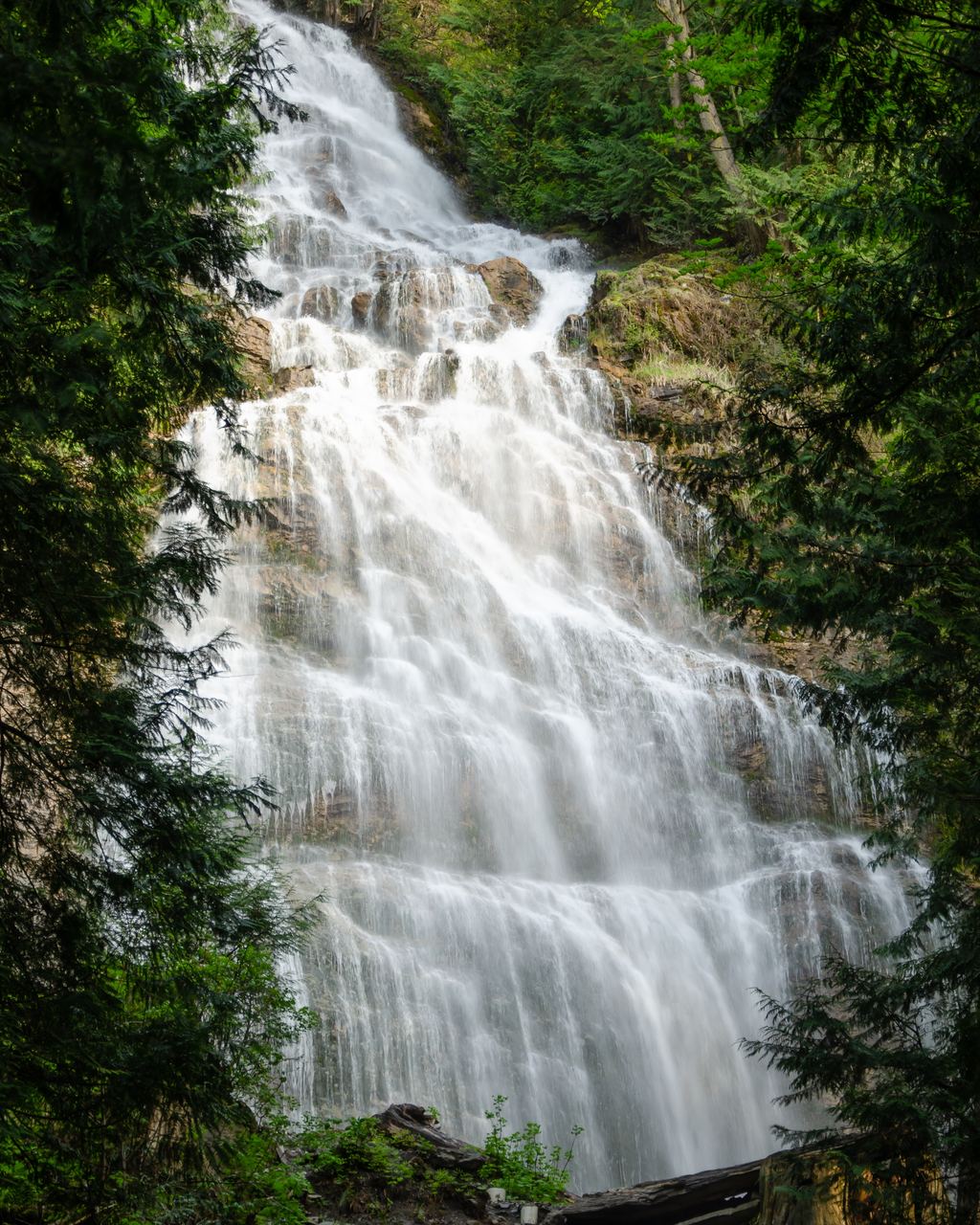
Three sources, three tests. Ford's 1968 definition, reproduced by Goudie, makes a cascade a fall of only a few feet, or a succession of such falls, and treats cataract as a plain synonym of waterfall. National Geographic Education describes a cascade as a waterfall that descends over a series of rock steps, yet its own vocabulary box says waterfalls are also called cascades. The Database defines it by the surface: water over gradually sloping rock, a run of small steps in quick succession or a rugged slope, and it adds that cascades can be both gradual and steep.
Ford sets a size, National Geographic a shape and the Database a slope. In Mount Rainier National Park the Park Service calls Ranger Falls, 172 feet in total, a "dramatic cascade", and it calls Fairy Falls a 3-tiered cascade that drops nearly 600 feet. Size is clearly not what the word means there. National Geographic also lists a chute: a waterfall where the stream passage is very narrow and the water is forced through at unusually high pressure.
Tiered or segmented: steps in a row or channels side by side?
The Database defines tiered as multiple distinct drops in relatively close succession, and admits that whether a fall with two visible drops counts is "up to the beholder". National Geographic calls the same thing multi-step: connected waterfalls, each with its own plunge pool, with Plitvice Lakes in Croatia as its example. At Mount Rainier the Park Service writes 2-tiered for Ohanapecosh Falls, which drops nearly 70 feet into double plunge pools, and calls Fairy Falls 3-tiered. It defines the word nowhere. Labels, not definitions. We found no institutional definition of tiered at all, so the Database's wording is the only one we can give.
Segmented is the trap. National Geographic says the flow separates as distinct streams, and the Database says the stream is broken into two or more channels before it reaches the cliff, so several falls run side by side. The Park Service's 3-segmented Ranger Falls is nothing of the kind: it has several drops in a series. Two reference sources and one national park give you three pictures from one word, and only the first two agree with each other. If a listing calls a waterfall segmented, look at the photo before you believe either picture.
| Term | As used by one source | Where another source differs |
|---|---|---|
| plunge | National Geographic Education: loses contact with the hard rock, unlike a horsetail | Database: loses most or all contact, and treats cataract and vertical as other names for it |
| horsetail | National Geographic Education: keeps contact with the hard rock underneath | Database: constant or semi-constant contact, nearly vertical or very gradual |
| cascade | Ford 1968, via Goudie: a fall of only a few feet, or a succession of them | National Geographic: a series of rock steps. Database: stepped or sloping rock, gradual or steep |
| tiered | Database: multiple distinct drops in relatively close succession | National Geographic calls it multi-step. Mount Rainier uses the label without a definition |
| block | National Geographic Education: descends from a wide stream | Database adds a test: the fall is wider than it is tall, not necessarily a solid sheet |
| segmented | National Geographic Education: the flow separates as distinct streams | Mount Rainier: Ranger Falls is 3-segmented, meaning several drops in a series |
| cataract | Ford 1968, via Goudie: a synonym of waterfall | National Geographic: powerful, even dangerous. Database: vertical with a large volume of water |
| punchbowl | National Geographic Education: wide pools at the base | Database: a narrow stream shot outward and downward into a large pool |
| fan | National Geographic Education: water spreads out horizontally as it descends | Database: the base looks much wider than the top |
| brink | Mabin, via Goudie: a clear lip at the top of the fall | Database: the top of a waterfall, also called the crest |
| plunge pool | Database: a pool at the base formed by hydraulic erosion | Gilbert 1907: at Niagara the hollow is deeper than the fall is high |
| tufa | Plitvice park: porous rock made by plants, algae and mosses from dissolved calcium carbonate | The park's own captions say travertine. Database limits travertine to caves and hot springs |
| spray zone | No source we read defines it | UNESCO writes splash zone and spray plume. A Wells Gray report writes sprayzone |
Block, fan, punchbowl, cataract: what do the shape words add?
A block waterfall, in National Geographic Education's wording, descends from a wide stream. The example is Niagara Falls. Its tour pages are on this site, and the Database is the only source we read that gives a test: the fall has to be wider than it is tall, though it need not be a solid sheet of water. A fan spreads out horizontally as it descends, and the Database says its base then looks much wider than its top. A punchbowl has wide pools at its base according to National Geographic, while the Database describes a stream squeezed into a narrow channel and shot outward and downward into a large pool, a form it names after Punch Bowl Falls in Oregon.
The loosest word is cataract. Ford calls it a synonym of waterfall. National Geographic reserves it for a powerful, even dangerous fall and gives the Iguazú River, on the border between Brazil and Argentina, as its example. The Database treats it as a vertical fall with a large volume of water, often interchangeable with plunge. At Victoria Falls it is a proper name: UNESCO's statement lists Devil's Cataract at 61 meters and Eastern Cataract at 98 meters. Iguazú Falls has tour pages on this site as well.
What are the brink, the plunge pool and the spray zone?
The brink is the top edge, where the water leaves the rock. Also called the crest. That is the word Grove Karl Gilbert used in USGS Bulletin 306 in 1907, when he reviewed the surveys of the crest line of Niagara Falls. A plunge pool, in the Database, is a pool at the base formed by hydraulic erosion. Gilbert measured something sharper at Niagara: under the middle of the Horseshoe Fall the scour keeps a hollow whose depth is greater than the height of the fall. That describes one fall in 1907, not a rule. Our page on Niagara erosion and the 1950 treaty follows what has been measured since.
The spray zone has no definition in any source we read. UNESCO's statement for Victoria Falls writes of a splash zone and a spray plume about 500 meters high at most, and a report on waterfalls in Wells Gray Provincial Park in British Columbia, finished in March 2025, writes sprayzone as one word. Both mean the area the spray reaches. We use the phrase as a description, not a definition. Our page on waterfall wildlife and plants covers what lives there.
Tufa or travertine: which word is right?
Both, depending on who is talking. The Plitvice Lakes park defines tufa as a hollow, porous rock created from the deposition of dissolved calcium carbonate by plants, algae and mosses, and in a second definition as carbonate deposited at temperatures close to the ambient one. In its own photo captions the same park calls the barriers travertine. The Database reserves travertine for deposits formed in caves and around hot springs, which would make the Plitvice barriers something else. We use tufa for cold-water deposits like these and say so. Our guide to tufa and travertine waterfalls keeps both words in its title because both are in use.
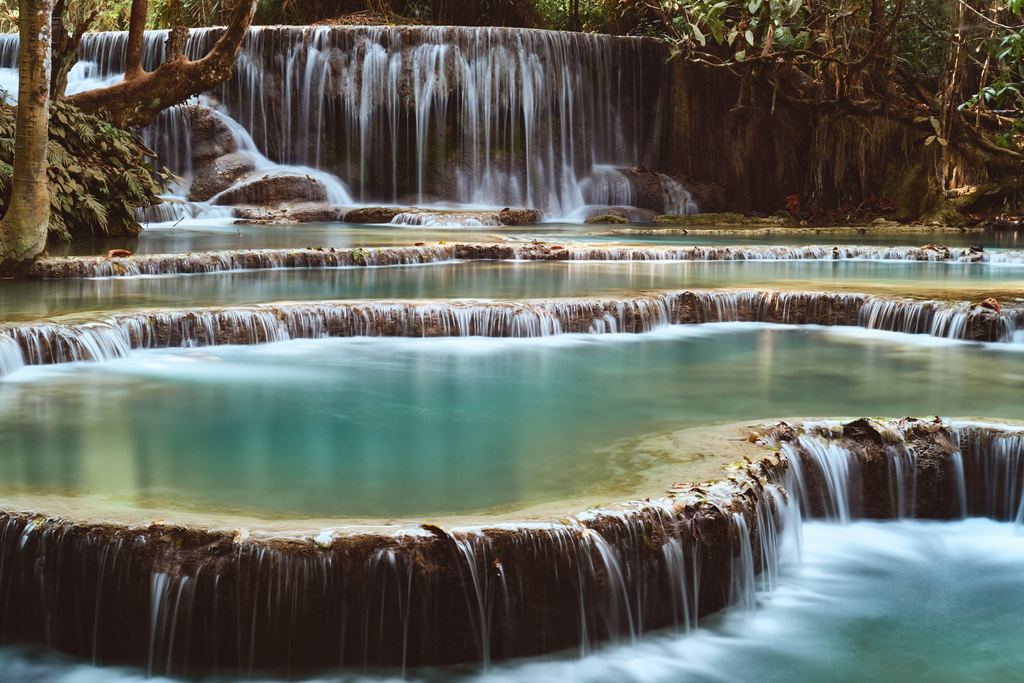
Goudie adds a third word. Gregory in 1911 called waterfalls that grow through carbonate deposits constructive waterfalls and named the Kerka falls in Dalmatia, a spelling of Krka, and the Pliva and Topolje falls in Bosnia as examples. One of them is on our list: Krka National Park. The Plitvice park puts the age of its active barriers at 6,000 to 7,000 years and names the moss Palustriella commutata as the species that most often takes part in building tufa. It also says the barriers keep changing the look of the lakes and waterfalls.
How should you read these words on a tour page?
Treat them as descriptions of how the water behaves, not as promises about the visit. That is all they do. A label such as horsetail or cascade says nothing about volume, season, access or whether anyone may enter the water, and the rules for that belong to each site; our guide to swimming at waterfalls shows how far they differ. How much water a fall carries in a given month is a separate question, taken up in when does a waterfall have water.
We do not classify waterfalls ourselves. This page reports how other sources use the words, and our How Waterfalls Form section covers why falls exist at all. How to choose a waterfall tour goes through what a listing can and cannot tell you, and the waterfall records page shows how a single number changes with the list it comes from.
Quick answers
Is a cataract a waterfall?
In Ford's usage, yes: cataract is a synonym of waterfall. National Geographic Education reserves it for a powerful fall, and the Database for a vertical one with a large volume of water. At Victoria Falls, UNESCO uses Devil's Cataract and Eastern Cataract as names of two sections.
Is a cascade smaller than a waterfall?
Not reliably. Ford's definition says a few feet, but National Geographic Education says waterfalls are also called cascades, and the National Park Service calls Fairy Falls, which drops nearly 600 feet, a 3-tiered cascade.
What separates a horsetail from a plunge waterfall?
Contact with the rock. National Geographic Education says a horsetail keeps touching the hard rock under it and a plunge loses that contact. The Database says a plunge loses most or all of it.
Is tufa the same as travertine?
The Plitvice Lakes park uses both words for the same barriers, while the Database limits travertine to deposits in caves and around hot springs. We use tufa for cold-water deposits.
Who decides which type a waterfall is?
We found no body that does. National Geographic Education says there is no standard way to classify waterfalls. Goudie reproduces its list and cites two other definitions, by Ford and by Mabin.
Data verified on . Read 2026-10-27: National Geographic Education, Goudie 2020, NPS Mount Rainier, Plitvice Lakes park, USGS Bulletin 306, UNESCO, World Waterfall Database. Editorial Policy
Plitvice Lakes, the tiered example
We earn a commission if you book through this link. The park's own rules and ticket terms are yours to check either way.