
The answer to which waterfall is tallest depends on what you count. Guinness World Records lists Angel Falls in Venezuela at 979 m total drop, with a longest single drop of 807 m. The World Waterfall Database, which Guinness itself cites for its flow records, puts Angel Falls 14th on its overall-height list at 807 m and puts Tugela Falls in South Africa first at 948 m. Neither source is wrong. They count different things, and width and flow work the same way. So every figure on this page is written the same way: value, metric, source, list, and the day we read it.
We earn a commission when you book a tour through the links on this site, at no extra cost to you. It does not change the numbers. Three of the waterfalls below are in our catalog: Victoria Falls, Niagara Falls and Iguazú Falls. The record holders for height, width and flow are not.
Which waterfall ranks first by height?
Start with Angel Falls, because it shows the problem. Guinness gives the total drop as 979 m and the longest single drop as 807 m, and says the falls were last surveyed in 1949, on a National Geographic expedition. It adds that there is now some debate over whether all 979 m belong to a single waterfall. If the true figure is only the first 807-meter drop, Guinness says, the multi-drop 948-meter Tugela Falls would be the tallest overall.
The database's own Tugela page goes further. It calls it extremely likely that Tugela is still the tallest recorded, and says the measurement often credited to Angel Falls was probably taken from nearly 2 kilometers away. It also reports that a Czech team measured 983 m at Tugela in 2016 from more than a kilometer off, and it calls that figure not accurate. The same page says Tugela is commonly described as five leaps and may have as many as seven or eight, so even the count of steps is open.
| Waterfall | Value | Metric | Source and list | Caution |
|---|---|---|---|---|
| Angel Falls, Venezuela | 979 m | Total drop | Guinness World Records | Last surveyed in 1949; debated as one waterfall |
| Angel Falls, Venezuela | 807 m | Longest single drop | Guinness; database single-drop list, 1st | Fourteenth on the database's overall-height list at the same 807 m |
| Tugela Falls, South Africa | 948 m | Overall height | Database overall-height list, 1st | Five leaps commonly said, up to eight possible |
| Mattenbachfälle, Switzerland | 930 m | Overall height | Database overall-height list, 2nd | Ahead of Angel Falls on that list |
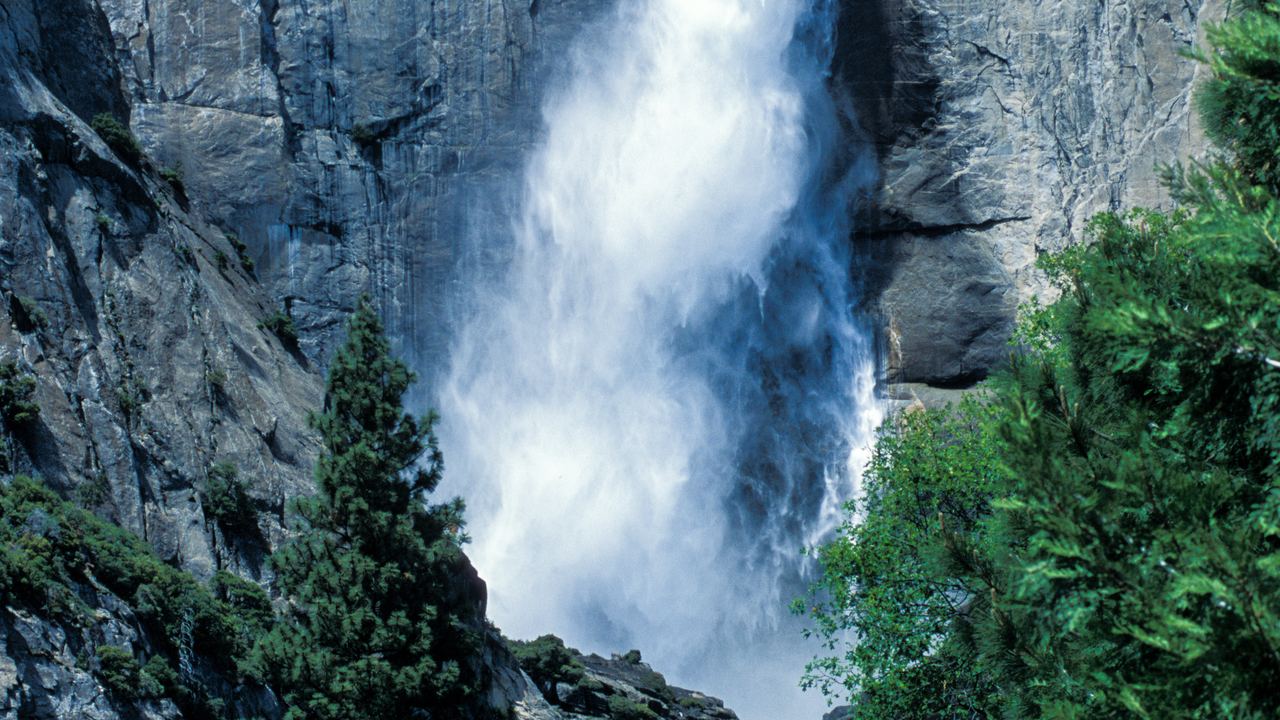
| Yosemite Falls, California | 740 m (2,425 ft) | Sum of three falls | Yosemite National Park (NPS) | Upper fall 1,430 ft, middle cascades 675 ft, lower fall 320 ft |
| Tugela Falls, South Africa | 411 m | Free-falling drop | Database free-falling list, 9th | Same waterfall, different metric |
Three lists, three answers. The database's overall-height list counts a waterfall of any kind, however many tiers it has. Its single-drop list counts only the tallest single step, and its free-falling list counts only the part where water leaves the rock. Angel Falls is 14th on the first and 1st on the second, at the same 807 m. The Swiss Mattenbachfälle, at 930 m, is second on the overall list. Few people have heard of it, and it sits ahead of Angel Falls.
Which waterfall ranks first by width?
Khone Phapheng Falls on the Mekong in southern Laos holds the top entry on the database width list: 10,783 m average width. The database's Khone page describes a series of falls and rapids that stretch about 10 kilometers from one edge to the other, rates the form as segmented rapids, and gives a maximum width of 12,954 m. That is not a curtain of water. It is a field of channels measured together, a different object from a single wall of falling water.
| Waterfall | Value | Metric | Source and list |
|---|---|---|---|
| Khone Phapheng Falls | 10,783 m | Average width | Database width list, 1st |
| Pará, Venezuela | 5,608 m | Average width | Database width list, 2nd |
| Iguazú Falls | 2,682 m | Average width | Database width list, 5th |
| Iguazú Falls | 2,700 m | Diameter of the semicircular fall | UNESCO World Heritage text |
| Victoria Falls | 1,707 m | Average width | Database width list, 11th |
| Victoria Falls | 1,708 m | Width | UNESCO and Zimparks |
| Rhine Falls, Switzerland | 150 m | Width | Rheinfall.ch, the official site |
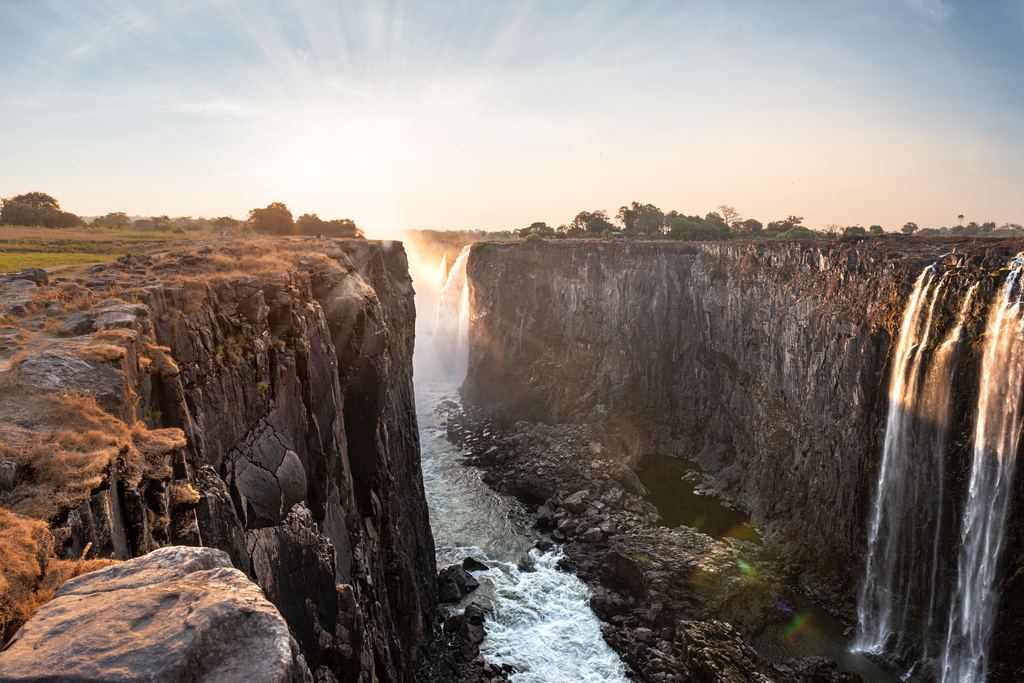
Victoria Falls is not first on any width list we read. It is 11th on the database's. Not close. UNESCO makes a narrower claim, the largest curtain of falling water in the world, and the Zambia Tourism portal explains the label as width and height combined. So Victoria Falls is a curtain record and not a width record. The same UNESCO text puts the falls at up to 500 million liters per minute, which is about 8,300 m³/s (our conversion), and Iguazú as a semicircle 2,700 meters across and 80 m high. Our guide to which side of a border waterfall to visit reads what the operators on each bank publish about those two.
Which waterfall carries the most water?
Flow is the least stable number of all. The database's list of average volume, which leaves out falls lost to dams, starts with Inga Falls on the Congo at 25,768 m³/s. Livingstone Falls on the same river follows at 25,060, and Wagenia Falls on the Lualaba at 16,990. Khone is fourth at 11,610. Niagara is seventh at 2,407, Iguazú ninth at 1,746 and Victoria Falls twelfth at 1,088. Guinness also gives Inga at 25,768 m³/s, and adds that there is some debate over whether Inga is a true waterfall or a series of rapids.
| Waterfall | Value | Database label | List position | Caution |
|---|---|---|---|---|
| Inga Falls, Congo | 25,768 | Avg. high volume | 1st | Guinness notes the debate over rapids |
| Livingstone Falls, Congo | 25,060 | Avg. high volume | 2nd | A long reach of rapids |
| Wagenia Falls, Lualaba | 16,990 | Avg. high volume | 3rd | Several cataracts in a row |
| Khone Phapheng Falls | 11,610 | Avg. high volume, 11 months | 4th | Page last edited in 2017 |
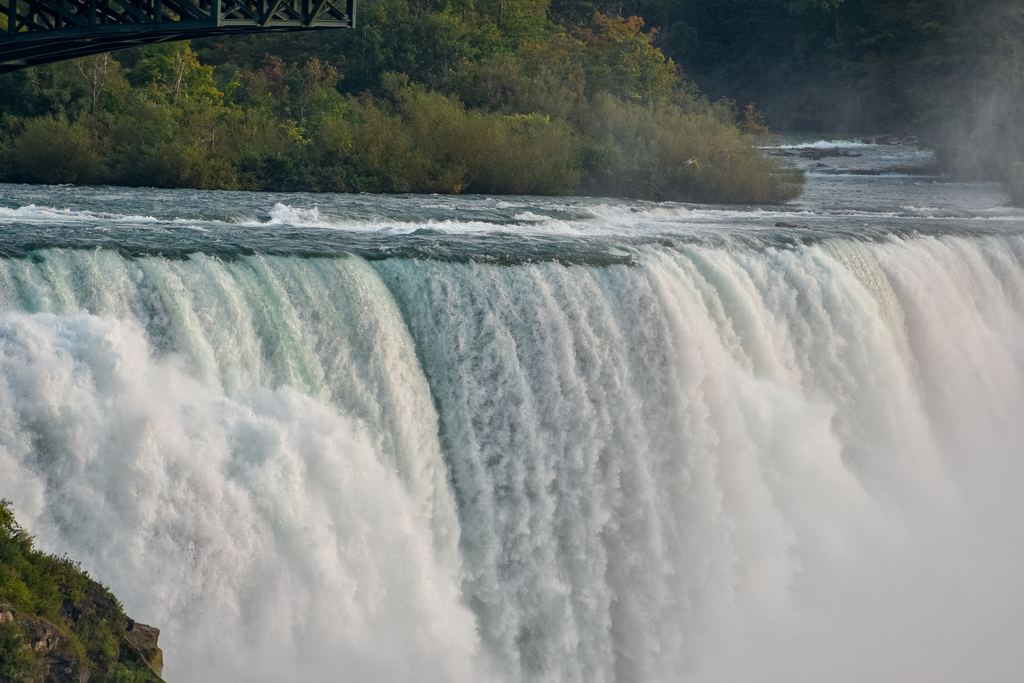
| Niagara Falls | 2,407 | Avg. high volume | 7th | A regulated flow |
| Iguazú Falls | 1,746 | Avg. high volume | 9th | A reading of 11,800 on 12 October 2026 |
| Victoria Falls | 1,088 | Avg. high volume, 8 months | 12th | Zambezi River Authority gives 1,100 as a yearly mean |
Read the label. The database's entries say average high volume, with a count of months attached: 11 for Khone, 8 for Victoria Falls. That is an average over the high-flow months, not over the year. It explains a strange pairing. The database's Victoria Falls page gives 1,088 m³/s for the 8 high months and 42 m³/s for the other 4, and weighting those two by their months gives a yearly mean near 740 m³/s (our arithmetic). The Zambezi River Authority, in its river flow bulletin, gives the long-term mean annual flow at the falls as 1,100 m³/s. Both cannot describe the same river over the same years. The database lists the source as unknown, and the page was last updated on 19 March 2017. We cannot say which is off, so each is used only with its label.
A reading is not a record, and a record is not an average. At Iguazú, the Brazilian concessionaire reported 11.8 million liters per second on 12 October 2026, which is 11,800 m³/s and almost seven times the database's 1,746. Its later bulletin gives a historical mean of 1.5 million liters per second, or 1,500 m³/s, much closer to the database. On the Zambezi, the same ZRA bulletin lists a highest recorded flow of 10,000 m³/s in March 1958. Our guide to when a waterfall has water explains why one number cannot stand for a whole year.
Is there a waterfall under the sea?
The National Ocean Service says one lies beneath the Denmark Strait, between Iceland and Greenland, with a downward flow estimated at over 123 million cubic feet per second, about 3.5 million m³/s (our conversion). NOAA describes cold, dense water from the Nordic Seas sinking below warmer water from the Irminger Sea and pouring over a step in the ocean floor. Guinness agrees on the name, says the cataract was discovered in 1989 and states that no terrestrial waterfall is as high.
| Quantity | NOAA's number | Our conversion |
|---|---|---|
| Flow | Over 123 million cubic feet per second | About 3.5 million m³/s |
| Top of the cataracts | 2,000 feet below the surface | About 610 m |
| Bottom | 10,000 feet | About 3,050 m |
| Drop implied by those two | 8,000 feet | About 1.5 miles |
NOAA's own description has a flaw. The page contradicts itself. It calls the drop nearly two miles, and its own two depths make it a mile and a half. The agency gives both numbers on one page and does not reconcile them. Nobody visits this one, and no tour sells it.
Which European waterfall claims the title for power?
Two European operators claim a title, and the titles are different. The Rhine Falls site calls the falls Europe's largest waterfall and gives a width of 150 m, while the Vatnajökull National Park page for Dettifoss in Iceland says it is the most powerful waterfall in Europe and gives 44 to 45 m high and about 100 m wide. Both are claims.
The Swiss site also shows a live discharge reading from the federal environment office beside its claim. The Icelandic page, as far as we could read it, carries no flow figure. Largest and most powerful are not the same measure, and a site can pick the one it wins. We report both, each with the metric it uses. Dettifoss is on our North Iceland page.
How do you read a record claim?
Five questions sort most of the confusion. Ask them in this order.
| Question | Why it matters | Example here |
|---|---|---|
| Which metric? | Total height, single drop, free-falling drop, width and volume are different records | Angel Falls: 979 m total, 807 m single drop |
| Which list? | A position depends on what the list leaves out | Victoria Falls: 11th by width, 12th by volume |
| Which year? | Old surveys and old pages stay in circulation | Angel Falls surveyed in 1949; two database pages from 2017 |
| Who measured? | An operator, a database and a press release are different grades of evidence | Dettifoss and the Rhine Falls both claim a European title |
| Which unit? | Liters per second, cubic meters per second and liters per minute differ by factors of 60 and 1,000 | Iguazú: 11.8 million L/s is 11,800 m³/s |
A record without its metric is a slogan. Before you repeat a number, write down which measure, which list and which year it belongs to.
None of this makes the records meaningless. It makes them dated claims. If you are choosing a waterfall to visit, size is a poor guide to the visit, and how to choose a waterfall tour is a better place to start, and our guide to how waterfalls form covers what shapes the falls behind the numbers. Words used in this guide, such as cataract, plunge and segmented, are defined in our glossary of waterfall types, and short answers to the questions people ask most are in the waterfall FAQ.
Quick answers on records
Where does Angel Falls rank by height?
It depends on the list. Guinness gives 979 m total and 807 m for the longest single drop. The World Waterfall Database ranks it first on single drop and 14th on overall height, behind Tugela Falls at 948 m.
Where does Victoria Falls rank by flow?
Twelfth on the database's average-volume list, at 1,088 m³/s, with the caveat that the database figure covers only the high-flow months. UNESCO's claim is about the size of the curtain, not the volume.
Where does Niagara rank by flow?
Seventh on the database list at 2,407 m³/s. The flow over Niagara is regulated, so the figure describes a managed river and not an unregulated one.
Why do two sources give different heights for the same waterfall?
Because they count different things. One adds the cascades and rapids below the main drop, another counts only the longest unbroken step, and a third counts the free-falling part. Yosemite Falls is 740 m as three falls in one source and has a different step count in another.
Is there a waterfall in the ocean?
NOAA says there is one under the Denmark Strait, formed by cold water sinking below warmer water. It describes a drop from 2,000 to 10,000 feet and does not reconcile that with its own phrase about a two-mile drop.
Data verified on . Read on 2026-10-27: Guinness, NOAA, NPS, ZRA and the database directly; UNESCO and Zambia Tourism through the Internet Archive. Khone and Victoria database pages date from 2017. Editorial Policy
Victoria Falls, 1,708 meters wide
We earn a commission if you book through this link. The tour pages sort the falls by bank, so you can see which side a listing covers.